The passing of Martin Parr, described as ‘Britain’s best-known photographer’ marks the end of an era for British photography. Rather than write an obituary – there will be many of those to read over the next few weeks - it seems more appropriate to consider why he gained that label, his relationship with the RPS, and his legacy.
Martin’s career started with studying photography at Manchester Polytechnic (1970-1973) alongside contemporaries Daniel Meadows and Brian Griffin. He exhibited in a group show of young photographers in 1974 at Impressions Gallery, then in York, and the following year had a solo show Home Sweet Home. Both were reported in the RPS’s Photographic Journal without comment. Martin’s black and white projects of this period continue to equal his later, and better known, colour work.
By 1985 he was part of the first exhibition of British photography in China alongside the RPS’s Heather Angel FRPS. Martin’s career continued to grow and the project The Last Resort documenting holiday makers in New Brighton, exhibited and published in 1986, proved a major turning point, marking a shift from black and white to colour, and a distinctive style with fill-flash and close ups of his subjects. It divided critics but it remains a popular, recognisable, and important body of work.
The opening of the RPS’s National Centre of Photography in Bath provided the opportunity for the RPS to show and then tour The Cost of Living in 1990. The work captured a section of British society at the height of Thatcherism. Carole Sartain, who managed the exhibition for the RPS recalls: 'We had no idea the impact the exhibition would have at the time and the long term relationship that would develop with Martin. It was an honour and a privilege to work with him. He was a a tour de force and didn't take no for an answer; his work constantly made you question your opinions.'
Martin was sanguine about Margaret Thatcher’s claim that he was her favourite photographer. Such praise did him no favours when he joined the Magnum Photos agency.
Martin had mixed views about the RPS and its role in photography. He appreciated, I think, the role it played in supporting his grandfather George Parr’s interest in photography as a member of the RPS. George’s interest was picked up by Martin who took it in a new direction. In a BBC Radio 4 interview Martin claimed the RPS was traditional in its outlook had held back photography, although when I spoke to him about that he smiled and said he was being provocative. The RPS awarded Martin an Honorary Fellowship in 2005 and its Centenary Medal in 2008.
When the RPS moved next door to the Martin Parr Foundation in 2019 he frequently brought over visitors to see the current RPS exhibition. After visiting one of the RPS’s International Photography Exhibition, he said, it was not what he expected and not a traditional RPS exhibition. High praise! The Foundation and RPS collaborated on screenings, talks and particularly on the Bristol Photo Festival and BOP – Books on Photography – the photobook festival launched in 2019. BOP, largely through Martin connections pulled in an impressive range of public speakers.
A walk over to the Foundation for a meeting would generally find Martin on a sofa and questions “Have you seen this book?”, “What do you know of this photographer?”, “Would they make a good speaker?” or some gossip. Inevitably a new book or print acquisition would be passed over for an opinion. Martin’s own enthusiasm was infectious, and his knowledge detailed and extensive.
Legacy
Although his passing is still raw, I think for me, Martin’s legacy falls into several areas. His early documentary work such as the Non-Conformists in Hebden Bridge, Ireland, and elsewhere remains powerful, if understated, but continues to engage with audiences. His later work from The Last Resort onwards showed that colour, often with humour, and a distinctive way of looking at British life, traditions and society in a new way, will continue to resonate. Martin’s commercial work brought his approach to areas such as fashion.
His more than one hundred publications brought new audiences to photography away from the gallery wall. Some may disappear, but many will continue to be collected. His The Photobook three-volume series with Gerry Badger, from 2014, kickstarted the international interest in the history of the photobook and led to numerous other geographic and thematic studies. Those volumes continue to echo and inspire. Martin’s own book collections catalysed the Foundation via the Tate and now occupy its premises.
The Martin Parr Foundation which was set up in 2014 and opened in Bristol in 2017 provided a new place to show and collect the photography of photographers who had worked in Britain and Ireland, as well as providing a home for his own work. Unconstrained by traditional gallery or archive structures, and reflecting Martin’s interests, it offered a new place to see a diverse range of work, listen to photographers, read about them, and to preserve photography, often overlooked by other institutions, for the future. The Foundation, directly supported by Martin, did much to remind people that photography for Martin was not just an occupation. It was a passion and his life.
Less obvious, perhaps, other than to those he reached, was his generous and unstinting support of photographers. This ranged from students at the many universities where he spoke, to the many visitors, of all ages, who would turn up at the Foundation show work and be offered encouragement or advice. The many tributes to him from those photographers bear testimony to the impact he had.
Martin was seemingly everywhere: at art fairs, festivals, exhibitions, talks and events. He seemed to know everyone and brought people together in a way that few others are able to do, reflecting the esteem in which he was held and his celebrity status. Through those meetings and connecting people and institutions, he underpinned a wider ecosystem of British and international photography.
Martin was Britain’s best-known photographer. The BBC’s news bulletins yesterday and press obituaries are testament to that. He touched many thousands of people: enthusing them or inspiring them, simply by having met Martin Parr. His own photography across nearly fifty years speaks for itself. The Martin Parr Foundation, even without Martin’s presence, will, I am confident, continue to act as a place to see photography, and to learn.
Martin’s passing marks the passing of a particular generation of photographers, but his legacy will continue to inspire and encourage others to engage with photography, whatever that may look like in the future. In the same way that the young Parr was by his grandfather.
Dr Michael Pritchard
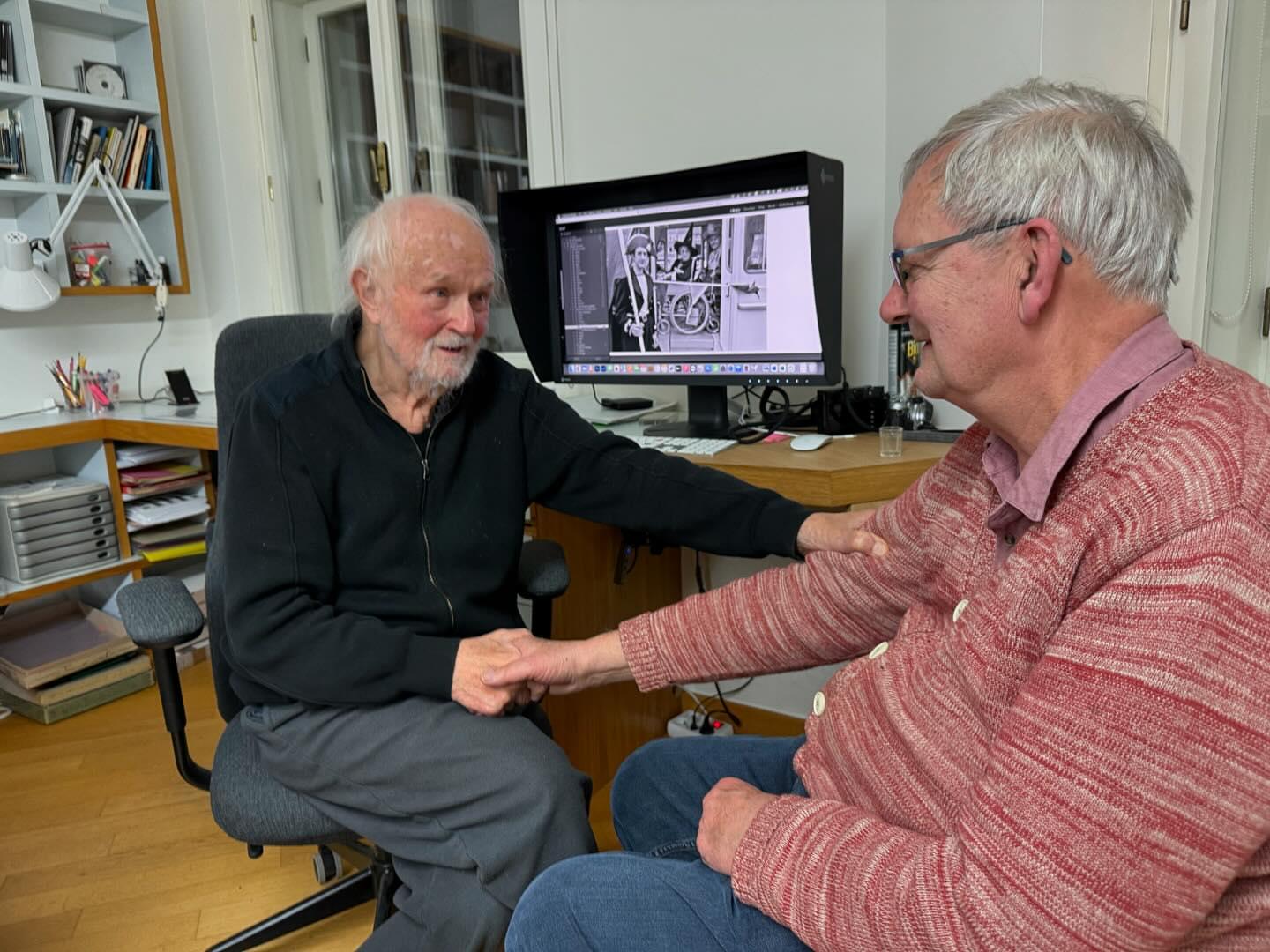
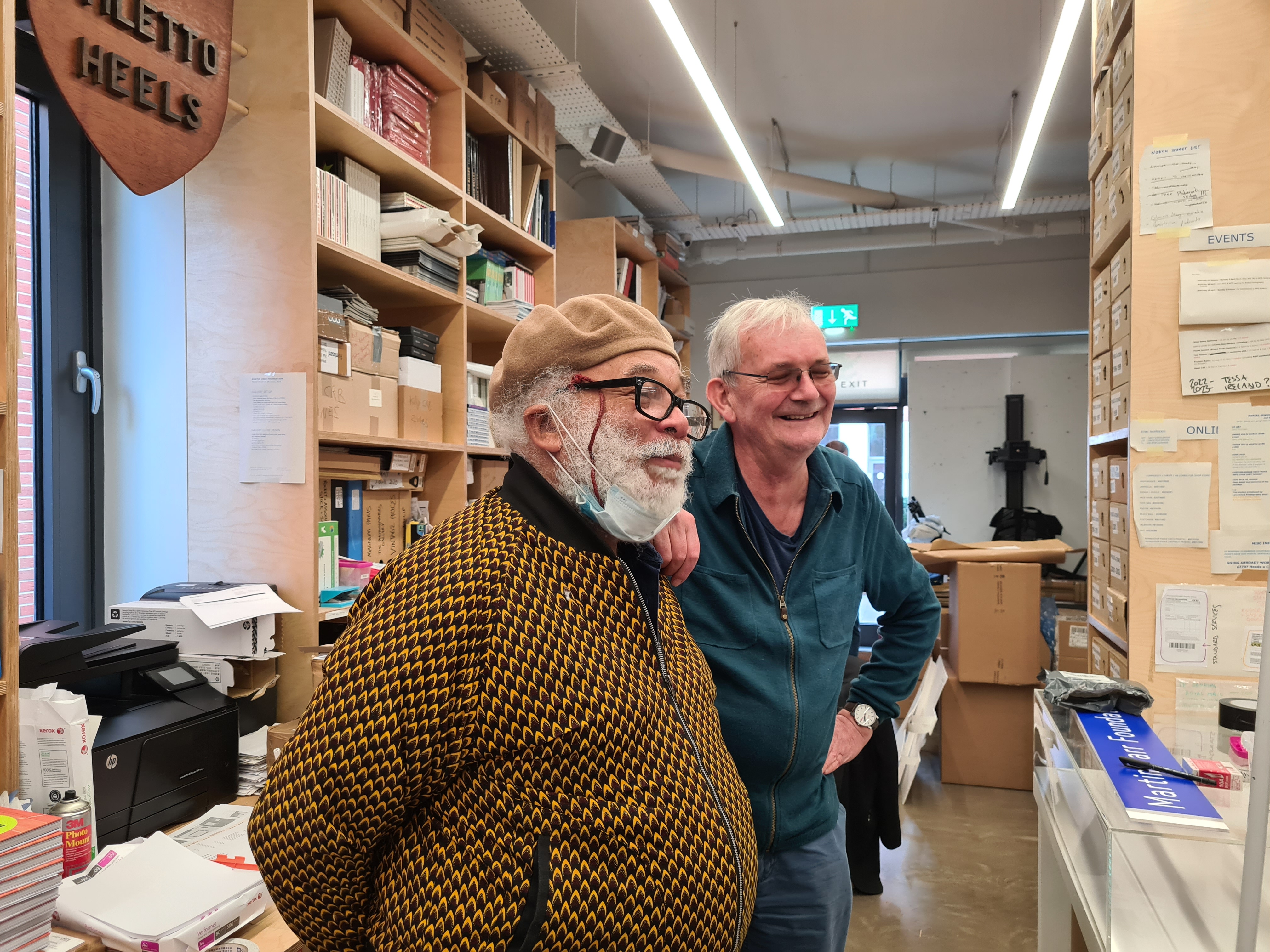
Images: Top: Martin Parr with photographer Charlie Phillips in the Foundation, October 2021, © Michael Pritchard. Below: Martin Parr with Josef Koudelka in October 2025, © Jon Tonks / Jon Tonks - Photographer