
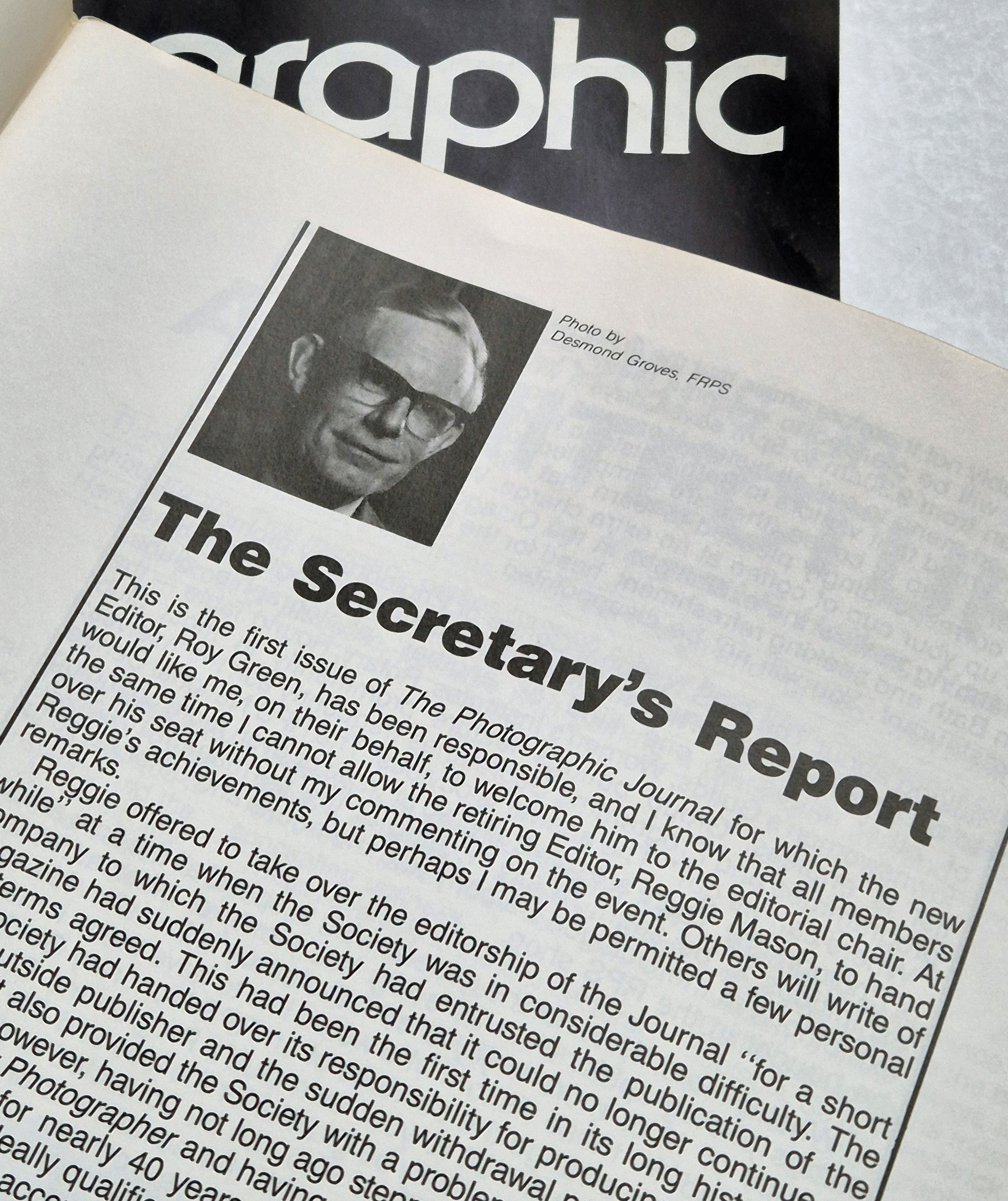
Kenneth Warr who was secretary of the Royal Photographic Society between 1969 and 1990 has died aged 100. He steered the RPS through a period of modernisation and moves within London and from London to Bath.
Kenneth Warr was appointed Secretary-designate of The Royal Photographic Society in August, 1969. Unlike his predecessor, Laurence Hallett, who, when he retired, was still a bachelor, he was by that time a married man and he and his wife, Jean, had a seventeen-month-old adopted son, Simon. Kenneth understudied Laurence Hallett, until he retired at the end of the year and then took over as the Society’s Secretary in January, 1970: he occupied that post until his own retirement at the end of July, 1990. His appointment caused some raised eyebrows - not to say serious doubts - among certain members of the Society and its staff for, since leaving Bristol University following his Army service, he had for some 20 years been a journalist, eventually becoming Managing Editor in London of UPITN, the world’s leading television newsfilm agency.
One of his first tasks on assuming office was to supervise the Society’s move from its temporary base over a travel agent’s premises in London’s Regent Street to its newly acquired Mayfair home at 14, South Audley Street which, after extensive alterations, was officially opened by H.R.H. Princess Margaret and her husband, Lord Snowdon, in November 1970. By this time the new Secretary had had time to assess the position which the Society held in the world of photography and formalize his ideas for the future. Of one thing he was convinced: whereas for an organization whose members had in the very earliest days of photography been in the vanguard of developments and whose own standing as an organization in the world of photography could not have been higher, now it seemed to be regarded with a considerable amount of antipathy and indeed many photographers - particularly professionals - had never even heard of it. This was a situation which, in his view, had to be confronted and remedied.
It was at this point that, at his suggestion and with the wholehearted encouragement of the Society’s then President, R. H. Mason, a ‘Royal Commission’ was assembled, consisting of a dozen or so individuals representative of various aspects of the Society itself plus two or three more from outside the Society whom, it was thought, could make a valuable contribution to its deliberations. Its terms of reference were to consider every aspect of the Society - membership, finances, activities, etc. - and to put forward recommendations for its future direction. Members of the Society and others were urged to submit their own ideas and criticisms and were given an assurance that every single communication would be given genuine consideration. The response was overwhelming and the members of the ‘Commission’ devoted many, many hours to their deliberations: their subsequent recommendations formed the basis of much of the Society’s policies and activities in the years that followed.
The changes did not come all at once but gradually they began to be introduced and gradually, too, the image which the Society presented to the ‘outside world’ began to improve with a consequent increase in its membership. Whereas before, virtually all the Society’s activities took place in London, now - following countrywide visits from the Secretary and the Past President, John Bardsley, Hon. FRPS - five Regional Organisations were established, each with its own programme of events, and more Special Interest Groups, such as Nature, Archaeological, Visual Journalism, and Historical, were also formed to supplement the existing six. The Society’s much-valued distinctions of Associateship (ARPS) and Fellowship (FRPS) were already recognized across the world as denoting exceptional photographic ability but in 1972 a new category, the Licentiateship (LRPS), was introduced which, although of not such a high standard, was not easily granted and over the years became both much sought after and a proven means of encouraging those who achieved it to strive for the higher distinctions. Yet a further development, introduced largely due to the persuasive efforts of the Secretary who was all too aware of the criticism which the distinctions assessment sessions held behind closed doors engendered, was the opening of some of the sessions to observers, a move which sought both to allay suspicions and at the same time to enable the entries for the distinctions to be seen and the expert comments of the assessors to be heard.
The opening of the Society’s new headquarters not only meant that members felt once again that they had a home of their own (and, for the first time, a bar in which they could have a drink) but also that there was now space to accommodate a variety of Society activities. One of the most popular (and financially profitable) was the introduction of Saturday All-day Workshops (with coffee, lunch, and tea provided) in which Fellows of the Society gave demonstrations and advice on various branches of photography. Opportunities were also provided for members to obtain one-to-one advice from a Fellow at what were called Photographic Advisory Panels.
With the Secretary intent on making the Society more widely known and appreciated, on several occasions in the mid-1970s, with the co-operation of a hotel group which accommodated those attending, conferences on a variety of photographic subjects, with distinguished lecturers such as Terence Donovan, Arnold Newman, Jacques Cousteau, and the Chief Photographer of NASA, were organized. They were held at the Odeon, Marble Arch on Saturday and Sunday mornings, attracted hundreds of photographic enthusiasts from both home and abroad, and since the Secretary was able to persuade the lecturers to give their services free of charge, provided additional income for the Society. Further efforts to convey the Society’s relevance to present-day photography included the launching, in co-operation with other sponsoring organizations, of the annual ‘Sports Photographer of the Year’ and ‘Royal Photographer of the Year’ competitions and exhibitions. Later, in 1980, the first World Photographic Conference was held in Singapore with the Secretary and several leading members of the Society playing a major role both in its organization and its programme .
Towards the middle of the 1970s Kenneth Warr presented to the Society’s Executive Committee a paper pointing out that, with the Society’s rates rising year by year and because in most years it was operating at a loss, when the 30-odd year lease of the South Audley Street premises expired, the Society would have no home and no resources with which to seek a new one. He therefore suggested that the RPS should seriously consider selling its lease while it still had some worthwhile value and seeking alternative, less expensive, accommodation. Understandably, the Society having only been in its present premises a few years, this suggestion caused no little consternation but, after earnest discussions over a period of months, the Committee decided that it would at least examine possible alternative sites and over the next couple of years investigated more than twenty other properties, most of them, but not all, in the London area. It was at this point that an Executive Committee member, Dr. Leslie Bowcock, whilst attending a medical conference in Bath, received a suggestion from the City’s Chief Executive that the Society should consider moving to Bath where he felt sure that suitable - and much cheaper - accommodation could be found. This was the beginning of a unique period in the life of the Society involving hours of discussion within the Society itself and between representatives of the Society and the Bath City Council. As these went on, gradually the idea crystallized of a National Centre of Photography, inspired and led by The Royal Photographic Society and located in one of the country’s most beautiful cities which attracted visitors from all over the world. As its Secretary, Kenneth was enthused by the potential which such a concept held out for the future of the Society and became one of its most fervent advocates. But if it was to become a reality, it would need the support - moral and financial - of the vast majority of individuals and organizations involved in photography. Much of the next few months was taken up with explaining the concept to as wide a constituency as possible and to discovering whether or not this would be forthcoming. Once it became apparent that there was every reason to expect that it would be, both the Society’s Council and the Bath City Council voted by substantial majorities to back the idea.
There then followed a worldwide appeal (organized and administered by the Society itself at a fraction of the cost which would have had to be paid to a professional fund-raising organization). Inspired by the boldness of the Society’s vision for the future, its members contributed generously to the appeal which, as a result of intensive lobbying, also gained the support of many of the major photographic manufacturers with the result that, as soon as it became evident that the target of £300,000 would be reached, work was able to begin on the conversion of the site eventually chosen for the Centre, the former Octagon Chapel together with the adjoining shop in Bath’s elegant main thoroughfare, Milsom Street. It was a major building project but on May 5th, 1980, the Society’s Mayfair headquarters of 14 South Audley Street was finally vacated and Kenneth, the Society’s Secretary, together with several other members of staff who had opted to move with the Society, travelled down by road to its new home in Bath. (Little did they know that, as they drove on their way past the Society’s former home in Kensington’s Prince’s Gate, by an ironic coincidence, a few hours later those premises, which now housed the Iranian Embassy, were to be partially destroyed as the SAS fought their way into them to bring to an end the siege in which for some six days Iranian Arab separatists had threatened the lives of 26 hostages.)
As for the Mayfair premises, the value of what remained of the lease had been considerably less than it might be by virtue of the restrictions imposed on the future use to which the building might have been put but, after prolonged negotiations, these were eventually lifted. Given a figure which he was instructed by the Executive Committee to accept should it be offered for the lease, Kenneth and the Society’s then Finance Officer, William Doyle, both of whom were convinced that it was worth far more, knowingly ignored their instructions for the next few weeks and encouraged a ‘bidding war’ between two commercial organizations eager to move into the premises: this resulted in the price eventually agreed being vastly more than that originally expected, so much so that a unanimous vote of appreciation for their efforts was recorded in the Minutes of the Committee’s next meeting. Later in the year Kenneth was awarded the Society’s Fenton Medal for “his personal contribution far beyond the call of duty in what for the Society has been a decade of momentous achievement”.
Opposition among the citizens of Bath to the Society occupying the Octagon which, for many years, had been a centre for various social activities such as dances and jumble sales, was at first considerable but, as the Society began to mount prestigious photographic exhibitions and increasingly began to play an active part in the cultural life of the City, such opposition subsided and the Society’s presence more and more welcomed. This became even more apparent when - even though, while the building work was still being completed, it had been operating since May 1980 - the RPS National Centre of Photography was officially opened by H.R.H. Princess Margaret on April 15th, 1981.
On the Society’s arrival in Bath and the opening of the exhibition galleries, a shop, a cinema, and various other aspects of the Society’s activities, it was only natural that initially it should need more staff but, fortunately, with the introduction of the then Government’s policy of encouraging work experience for some of the unemployed by paying their wages for those organizations willing to take them, Kenneth Warr was able to establish such good relations with the responsible Government Department that staff numbers increased substantially with little or no extra expense to the Society.
Although before moving to Bath the Society’s Executive Committee had accepted the fact that it would be some time before visitor numbers to the Centre’s exhibitions and sales in its shop were making a worthwhile contribution to its finances, there came a time when the Committee decided that such an outcome would more quickly be realized if a General Manager were to be appointed as the Society’s Chief Executive instead of that position being occupied by the Society’s Secretary as had been the case for over a century. As can be imagined, Kenneth Warr was not at all happy with this proposal and at the same time there was strong opposition from a large number of the Society’s membership. Even so, the new arrangement was implemented and, although - possibly to the surprise of many - the person appointed as General Manager, Lord Brain, and Kenneth Warr as Secretary became personal friends and worked together harmoniously, the arrangement did not produce the desired financial improvement and so, with Lord Brain’s departure, Kenneth Warr was asked by the Executive Committee once again to take over as the recognized Chief Executive.
It was largely due to the initiative of its Secretary, strongly supported by the then President of the Society, Arthur Downes, that, in the absence of an apparent willingness on the part of any other major photographic body to assume responsibility for organizing a suitable event to recognize the 150th anniversary of the invention of the negative-positive photographic process, the Society undertook to do so and on January 31st, 1989, a Gala Banquet was organized by the Society at the Savoy Hotel in London: its Guest of Honour was H.R.H. the Duke of Gloucester and, with over 150 present, the celebration was attended by representatives from virtually every branch of photography in the UK and overseas (and, incidentally, made a substantial profit for the Society!).
During the last few weeks before Kenneth’s retirement at the end of July 1990 there were two parties to mark the occasion, the first, on June 26th, at a West End club in London’s St. James’s Street and the second on the actual retirement day, July 28th, at the Octagon itself. Both events were packed with well-wishers who included not only RPS members and staff, but also colleagues from photographic organizations of every kind as well as - to his surprise on the last occasion - his wife, Jean, and son Simon. As the Society’s parting gift, the President, Brian Bower, presented him with the latest version of a Minolta word processor, the machine with which Kenneth had become so familiar since the Society itself had installed one at its headquarters. A short time later he was awarded the Society’s Honorary Fellowship.
Ironically, on that very retirement day his wife, Jean, received the news that the cancer which she had been fighting for the last 15 years had spread. It was a cruel blow and meant that the immediate years after Kenneth’s retirement were largely devoted to enabling that fight to go on. But it was a losing battle and Jean died in April 1993.
Kenneth was a man of many interests and his retirement afforded him more time to pursue them. In 1994, accompanied by his sister-in-law, he spent four weeks driving across the United States from Washington to Los Angeles. He was an avid reader; loved classical music; sang in his Church Choir; and did a variety of voluntary work. For 29 years he was a member of the Mayor of Bath’s Corps of Honorary Guides; he was a member of the Keynsham and Saltford Probus Club, of which he served as both President and Secretary; and was an Editor of Keynsham’s Talking Newspaper for the Blind. He was a Freemason and, having been educated at The Royal Masonic School for Boys, for 11 years after his retirement he edited the magazine of the School’s Old Boys’ Association of which he was elected its President for the year 1996-97. He was a keen theatregoer and since childhood had been active in the world of amateur theatre, both as actor and producer, but most of all he enjoyed writing for the theatre and over the years wrote, and saw performed on numerous occasions, several of his plays, pantomimes, and three musicals (one of which attracted the interest of a West End management) for which he wrote the scripts, lyrics, and some of the music.
In 2002 Kenneth married Catherine whom he had known for many years as his son Simon’s Godmother. Together they lived in the Wiltshire village of Hilperton. Catherine survives him as do Simon and three grandchildren.
Simon Warr
Kenneth Roland Warr (18 July 1925–25 July 2025), former Secretary of The RPS 1969-1990
An abridged version of this obituary appeared in the RPS Journal for October-December 2025