
Shining a light on everyday angels by Honey J. Walker ARPS
A moment of serendipity leads the photographer to an ambitious project recognising the work of charity staff, healthcare professionals and other caregivers — and raising much-needed funds along the way.
One never knows when something seemingly inconsequential can be a pivotal moment in one’s life. Four years ago I was sitting in my car with BBC Radio 5 Live on, listening to a segment with Naga Munchetty about a small charity called the Marylebone Project for women facing homelessness. My husband and I were in the process of selling our family business and had decided to give some of the proceeds to a charity. My husband wanted to focus on homelessness and I wanted to focus on women in crisis. We both agreed it needed to be a charity where we could see a direct impact. Call it serendipity, but that interview changed my life.
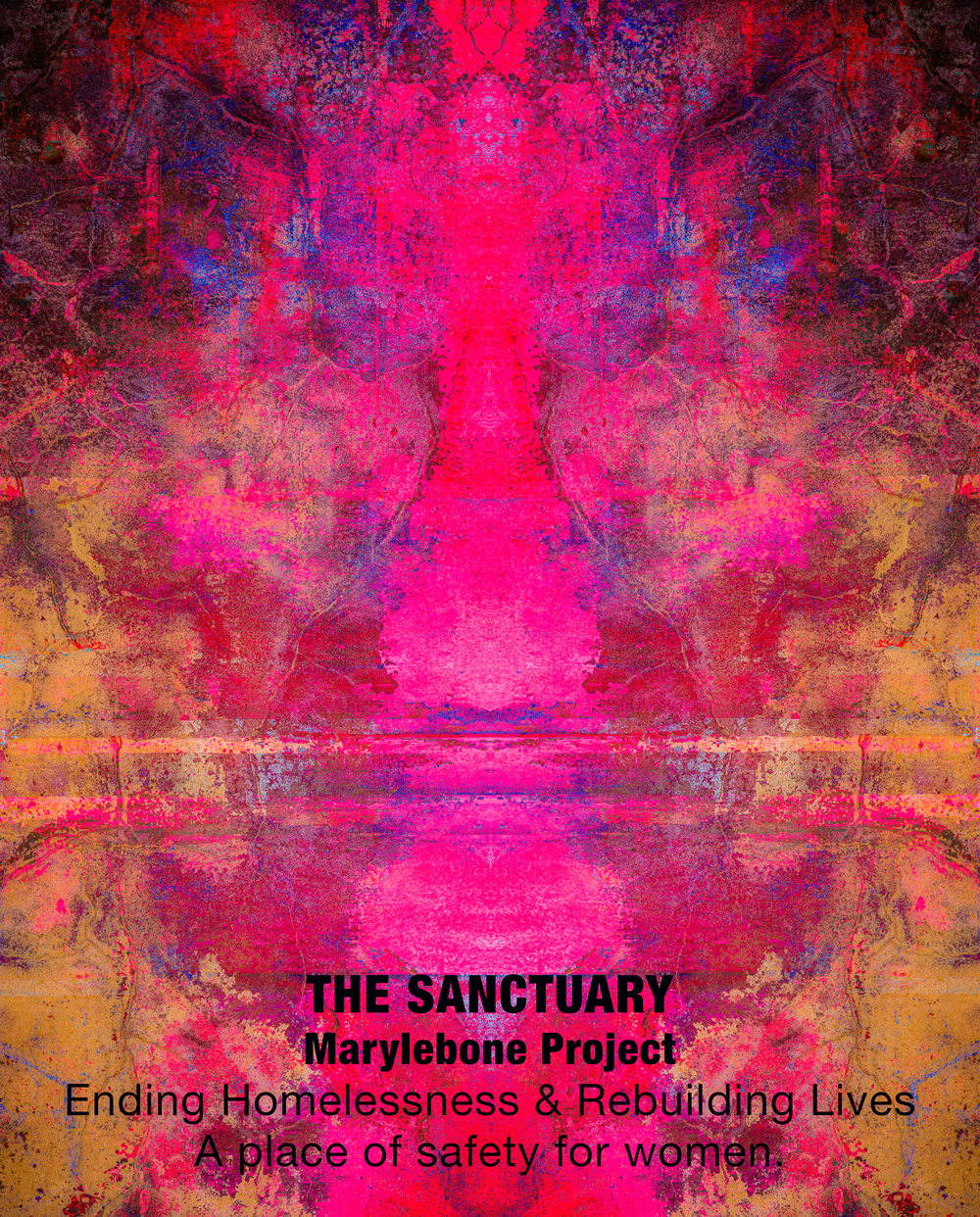
Today I am the ambassador for the Marylebone Project — a role I am immensely honoured to hold. The charity provides life-changing services for women facing homelessness and/or extreme crisis. It is the largest and longest-running centre of its kind in the UK. The centre has 112 beds on the Marylebone Road in London. The charity also operates the Sanctuary — the only 24/7, 365-day-a-year drop-in centre for women in the UK. My role is to raise awareness of the charity and its work and to raise funds and services. We need to raise £1.3 million each year just to keep the Sanctuary doors open.
All charities operate in a very overcrowded space. The ability to stand out and gain recognition and donations is increasingly difficult. Additionally, the public is much more receptive and empathetic to situations they have experienced or feel they might experience. Women and homelessness, domestic violence, abuse and trafficking are not on most people’s radar.
Yet abuse and violence against women has risen by 37% in the past five years in England and Wales — and that is only what is reported. London has become one of the primary centres for trafficking, especially of women, who invariably end up being prostituted.
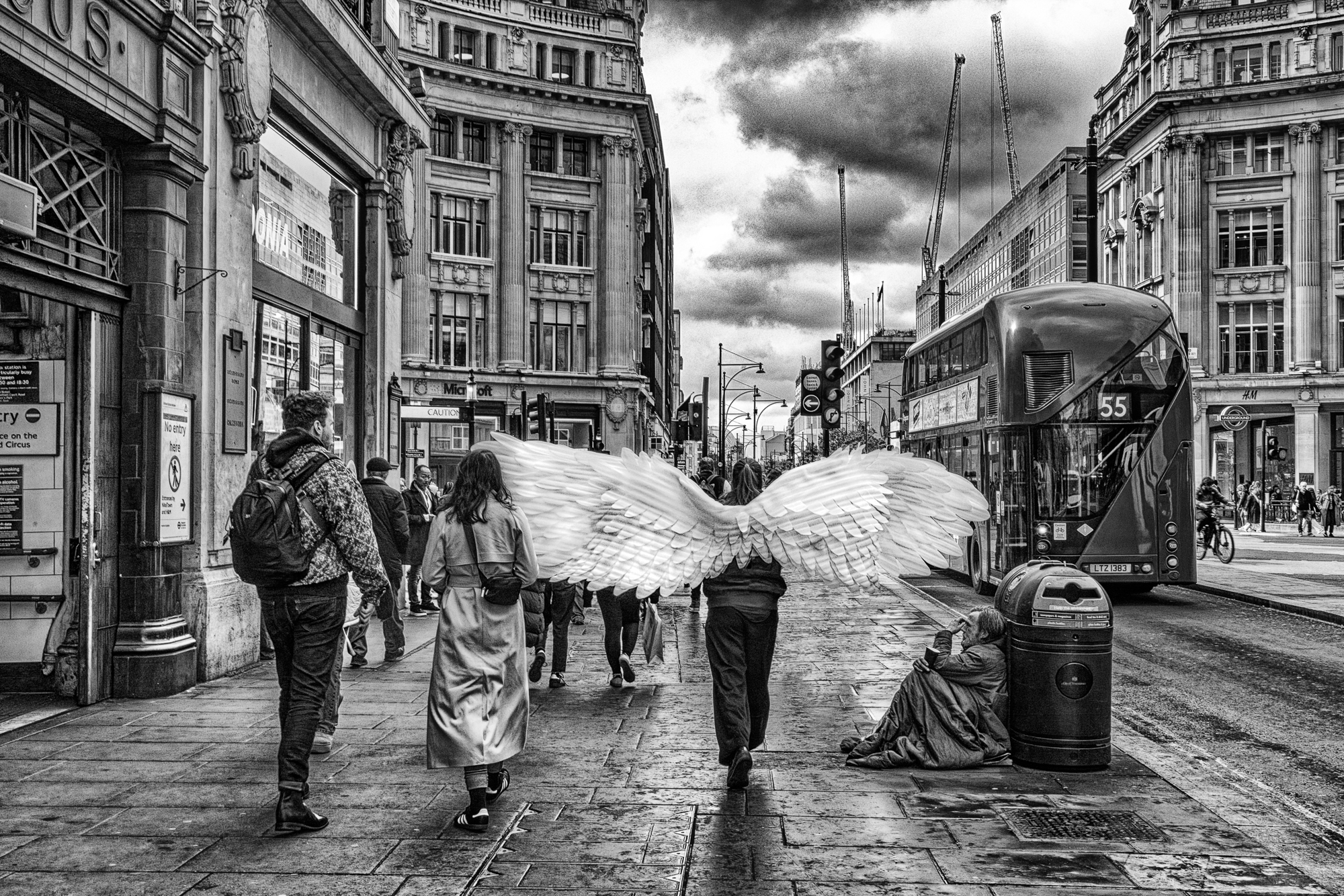
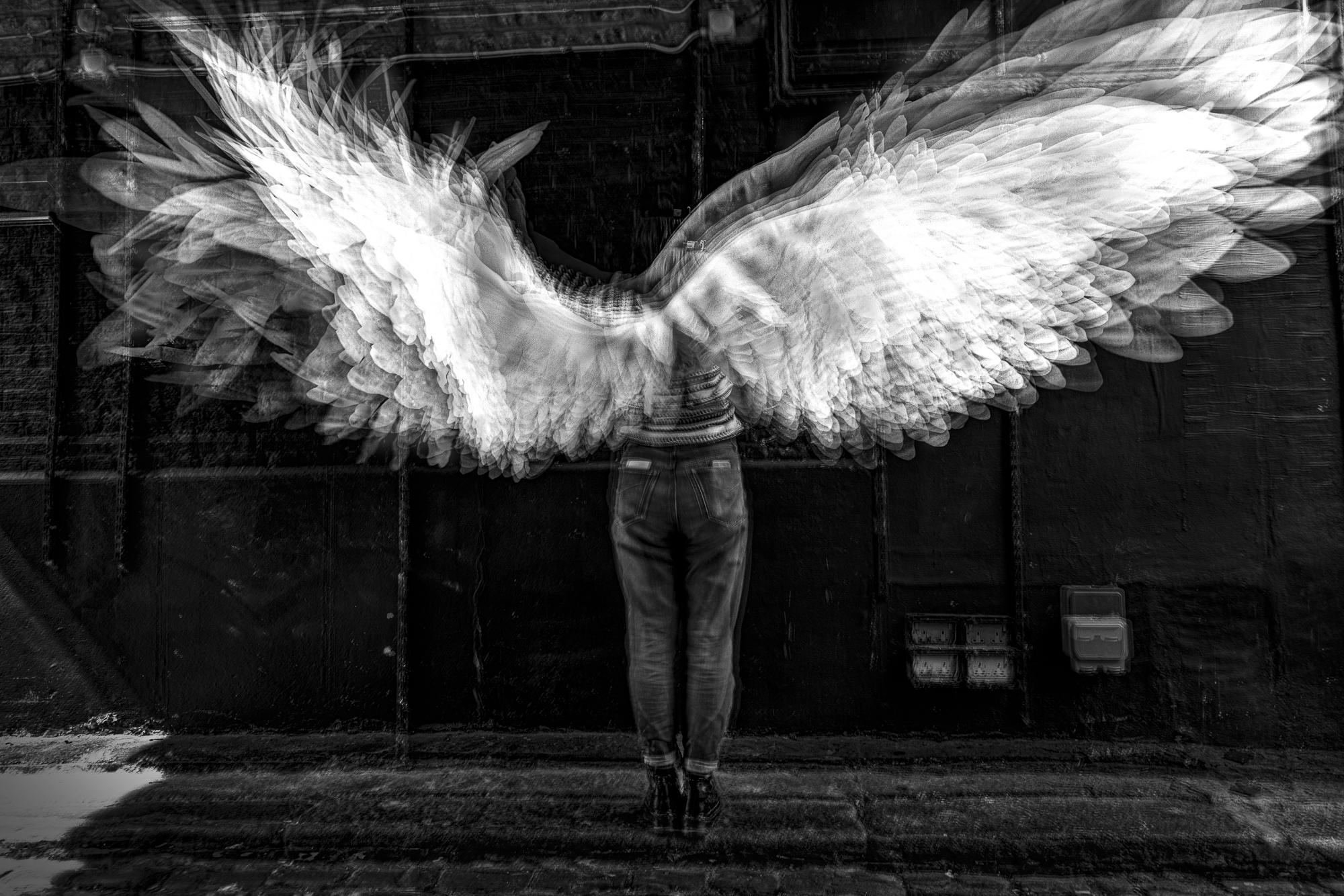
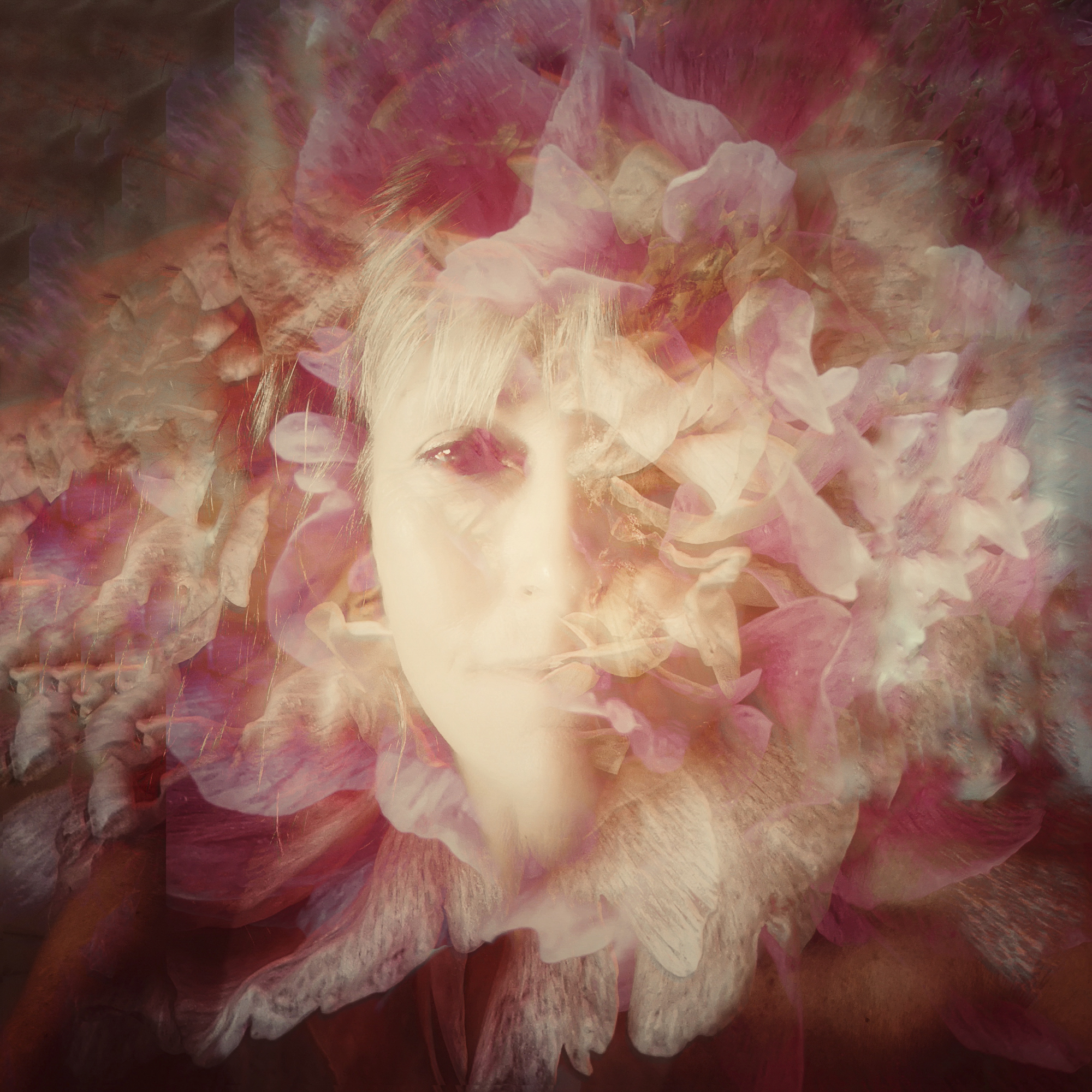
Header image: Why Are We Both Invisible?
Lightbulb moment
My first task within the charity was to redo their corporate sponsorship brochure. I had never designed a brochure for a charity, but I knew the importance of immediate impact and creatively standing out in a crowded market. It was a steep learning curve. I approached it by spending three days at the charity, meeting and listening to some of the residents. Their stories were truly harrowing but the shining light was the strength, safety and dignity that living at the charity had given them. After the new brochure was completed, the first corporate recipient doubled their original pledge.
Fast forward to Christmas 2023 and the charity’s staff party.
I made a speech to the staff about how important they were and the work they were doing. In essence, they were all angels.
Several of the staff approached me afterwards to say how their roles had never been spoken about in those terms before and how it had made them feel very proud. It was a lightbulb moment.
I decided to pitch a photographic project to the charity, which required taking the staff out onto the streets, wearing enormous angel wings, which I just happened to already own.
There were several goals: To recognise the staff and shine a light on all the caregivers in society, who are largely underappreciated and go unnoticed; to elevate awareness about the work of the Marylebone Project; and to raise much-needed funds for the charity.
I now realise the easy part was coming up with the concept!
There were several challenges. Firstly, the charity had to sign off on the idea. Next, I needed to find a central London gallery that would host the images for free! Unbelievably, Yield Gallery in Eastcastle Street, W1, embraced the idea and refused to take any commission. They gave me the most incredible space for 10 days at the end of November 2024 — perfect timing for an angel-themed event.
Yield Gallery normally sells everything from Banksy to Richard Hambleton so I felt suitably in awe and frankly terrified. I now had the responsibility of not only representing the charity and its staff in a good light but also creating images that were worthy of such a prestigious gallery.
A departure
My normal photographic and creative practice is very different from what I envisaged for this project. I create using multiple exposure, a bit of intentional camera movement, mixed media, gold leaf, collage — whatever interests me at the time. I always say my images find me — my subconscious finding oxygen. There is no conscious planning, I simply play. Colour is an integral part of my images. However much I restrict my palette, colours explode out all over the place.
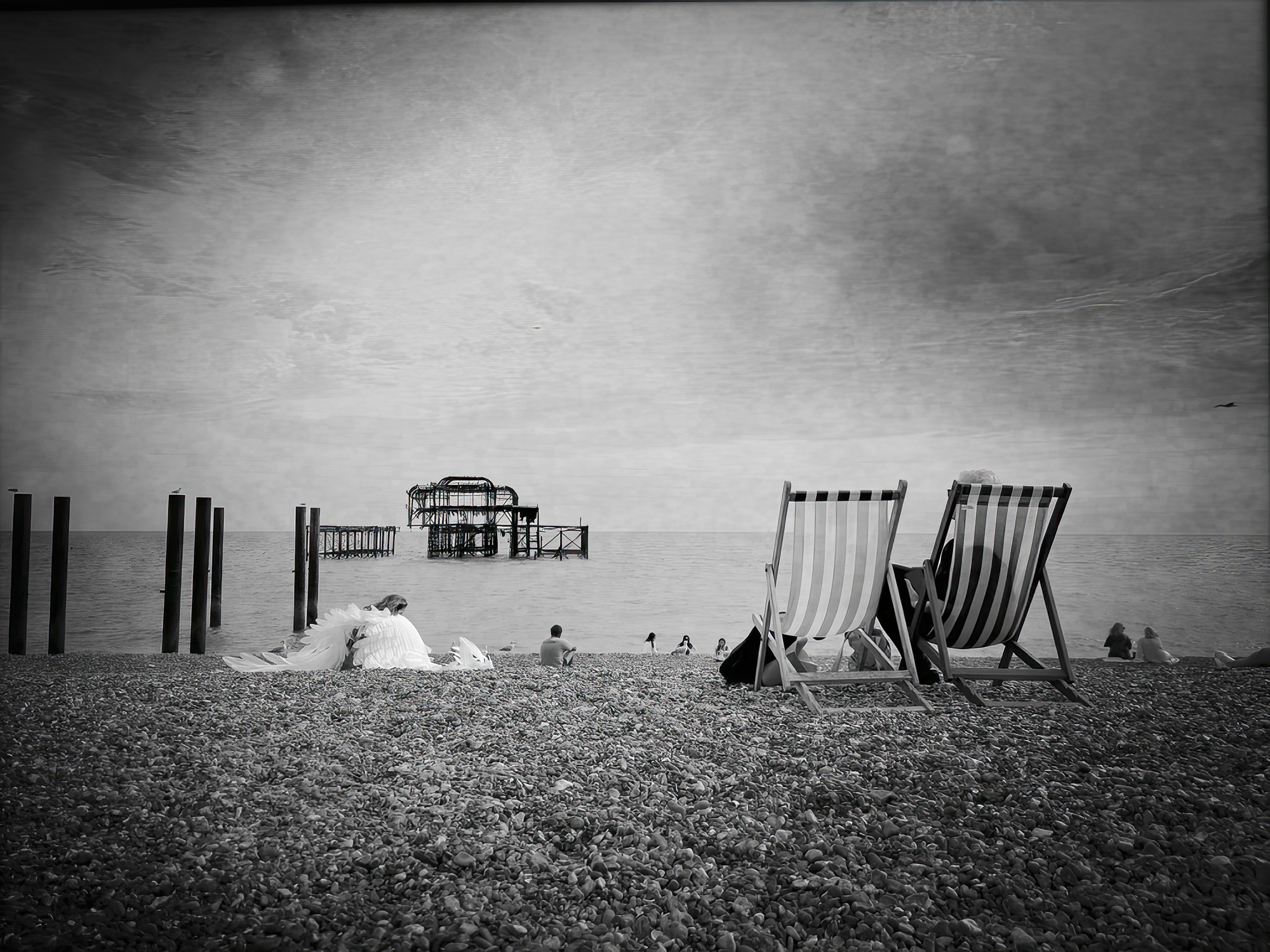
Are You Next To An Angel? would be completely different, involving many restrictions:
- Shooting in black and white.
- Street photography.
- Working with inexperienced, self-conscious models.
- Unpredictable public reaction.
- Bad weather — it rained a lot!
- Dodging security — it is difficult to photograph anywhere with giant angel wings and not get picked up on camera.
- Very limited shooting time as each model was given just one hour of paid time off work, including travel to locations.
- The models had to wear giant wings and look totally comfortable in them.
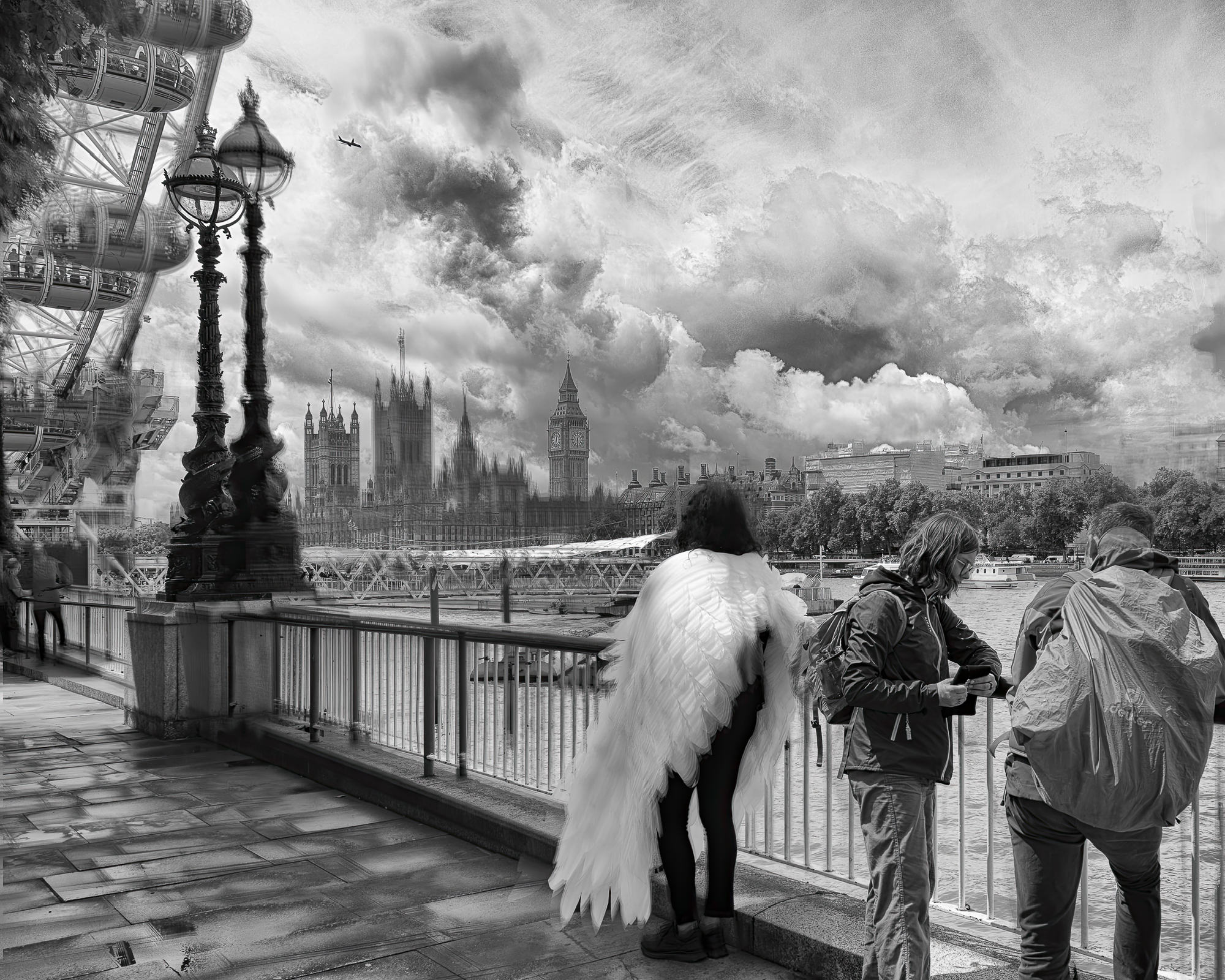
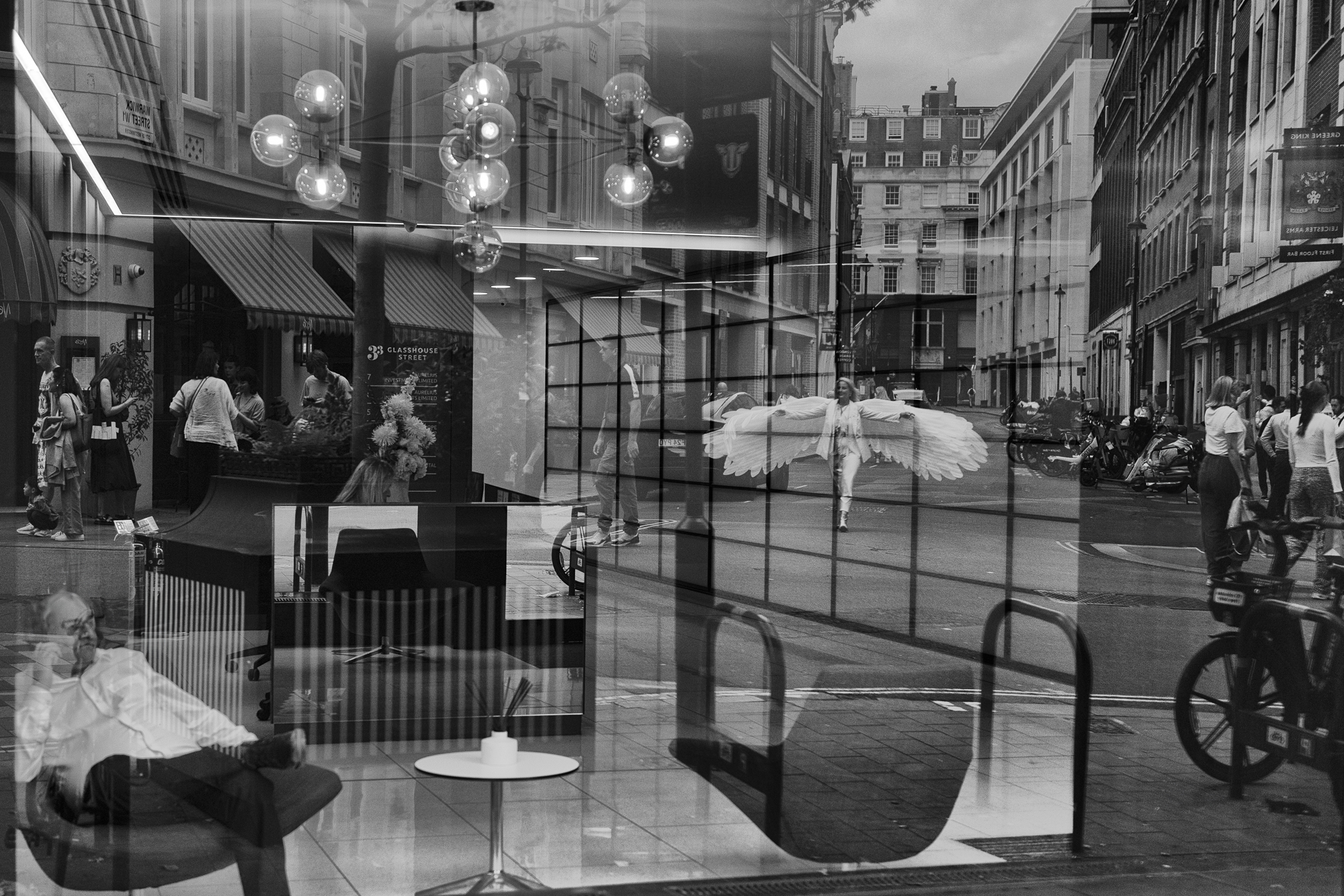
Locations were a mixture of iconic places in London given that the charity is based there, and quieter, everyday situations we can all connect to. Most importantly, each image had to tell a strong story in its own right without duplication. Managing my angels depended on how at ease the individual was wearing the wings in public. It took about 10 minutes to explain how I needed the angel to move and have a couple of practice runs with wing-flapping and walking speed. It was normally in the last few minutes of the shoot that everyone relaxed and the magic happened.
I shot the whole project with my trusty Canon R5 and a 24-105 mm Canon lens. I hate using Photoshop, so any editing I do is in Procreate which feels more intuitive. As much as possible I like to capture everything in camera.
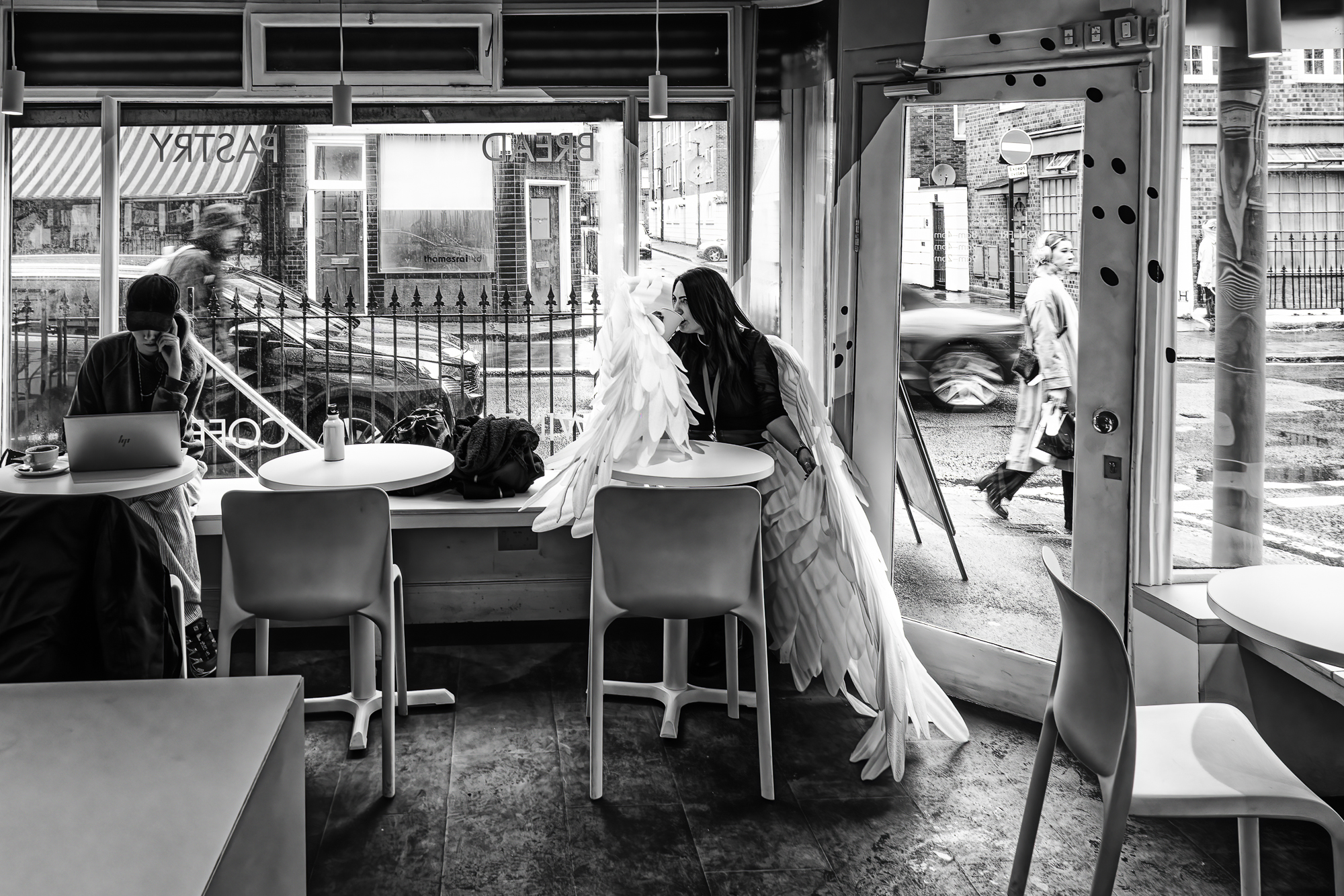
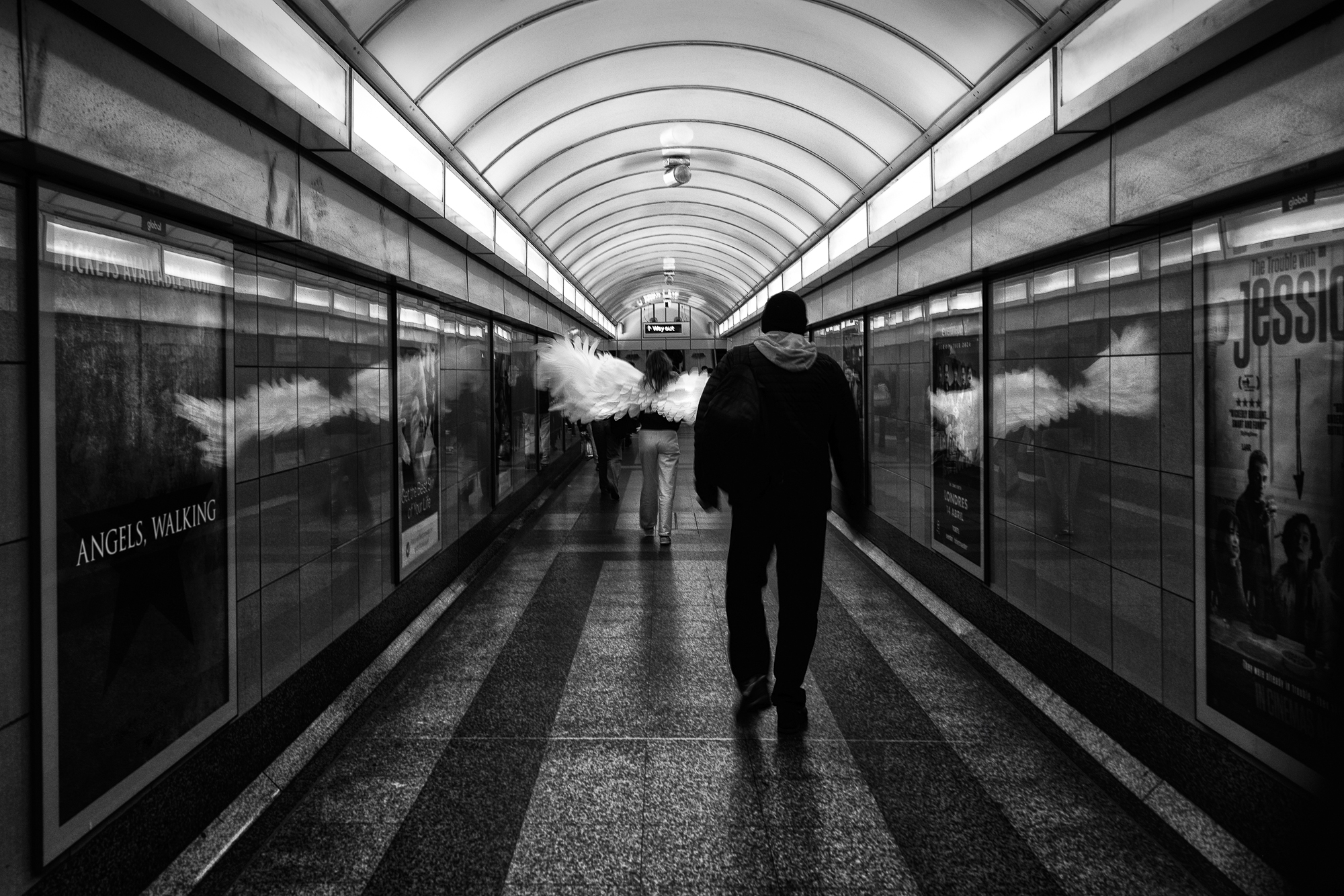
The project took nine months to shoot but from day one, it became apparent that the public were blind to the angels in their midst. Almost without exception, people did not notice the angel beside them on the tube, or in a cafe. As the photographer I was further back from my subject so I could see people’s eye line. Literally nobody noticed.
At a time when we are more digitally connected globally through our devices, we are also more polarised and more isolated from each other. By constantly looking down at a screen we are becoming more insular and self-absorbed.
Fight for your work
Early on I decided that I needed a second pair of eyes — someone with a wealth of black and white, documentary experience. I am a huge fan of Paul Sanders, former picture editor for The Times. I had met Paul in a Zoom workshop during Covid. He has a very insightful eye and understands the power of storytelling; he appeared to be perfect for the task.
Paul’s input was invaluable. He made me raise my game. When you greatly admire someone, you strive to produce work worthy of their time. Just the pressure of knowing I had to show a body of work to Paul made me properly assess the images. I would do an initial, drastic cull, after which I would present to Paul. My instincts were good and we mostly agreed on the next round of edits. There was one image that we disagreed on, that I felt very strongly about. It is essential to fight for your own work and be open to constructive criticism at the same time. Ultimately art is always subjective, but I was very connected to that particular image and I knew it worked.
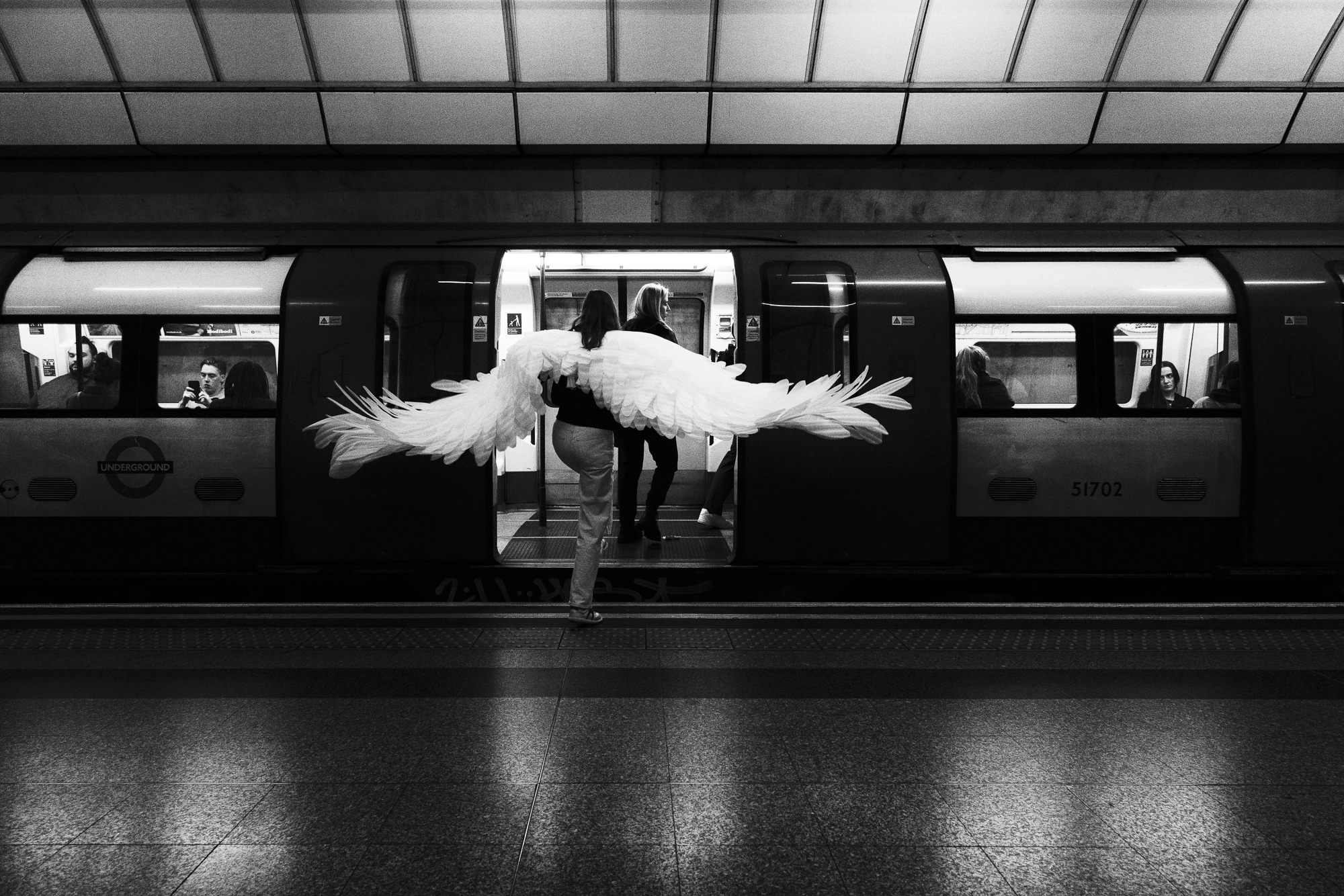
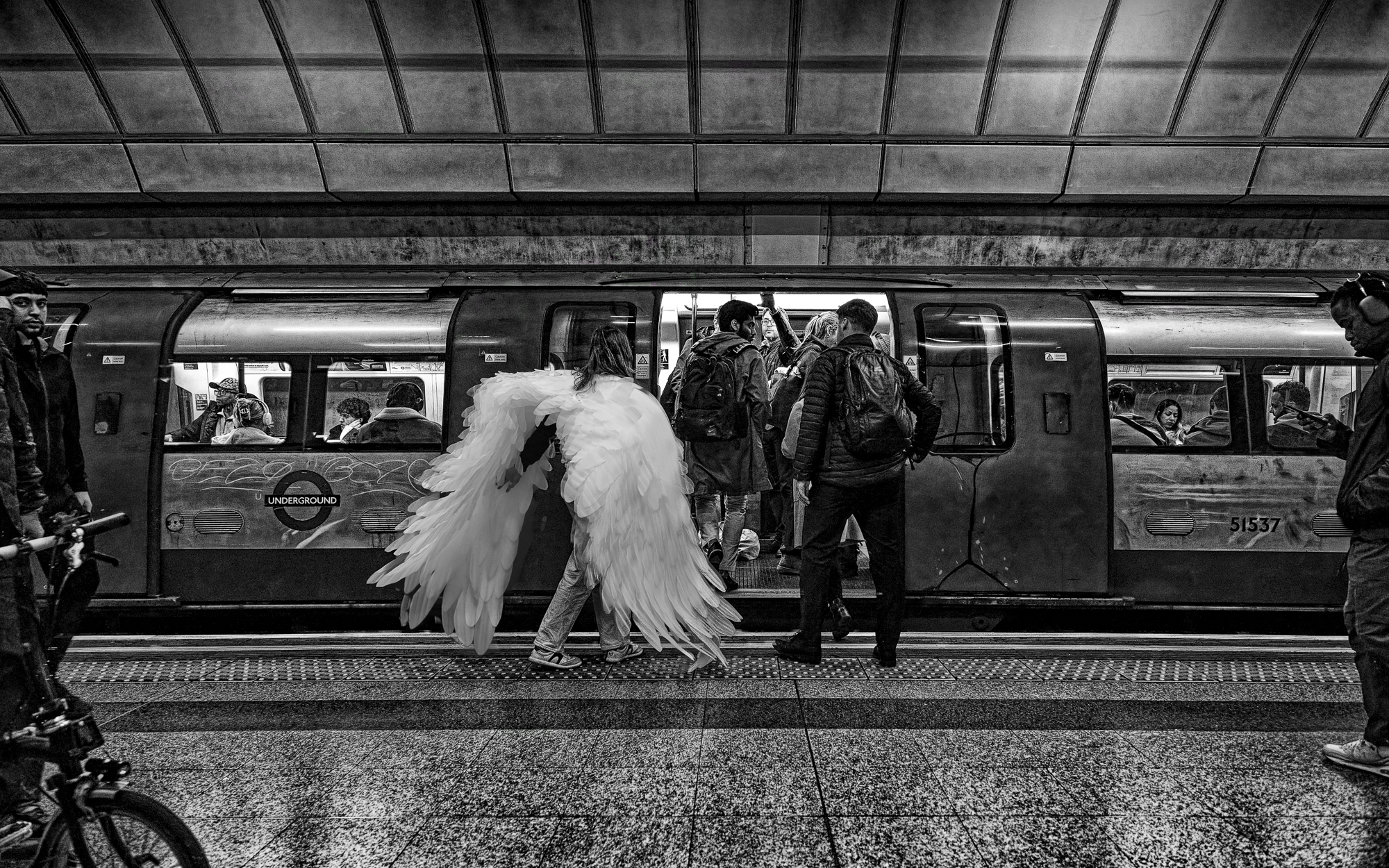
"Almost without exception, people did not notice the angel beside them on the tube, or in the cafe"
The images had to work both as a cohesive project and individually. The amount of wall space, size of framed prints, and pricing all had to be carefully considered. I self-funded the printing and framing to raise the maximum amount for the charity. One hundred percent of the sales price went directly to the charity. There was also the PR, social media, opening party and invitation list to decide on. The social media and PR aspects were excruciating, but it’s pointless having an exhibition that no one knows about or visits!
Full circle
I had set myself a target of raising £12,000 as this was the cost of printing and framing the images, hosting the party and so on. Any less than that and I might as well have written a cheque to the charity a year before and sat on a beach. In fact, we raised £43,500 with additional promises of services and potential grant funding.
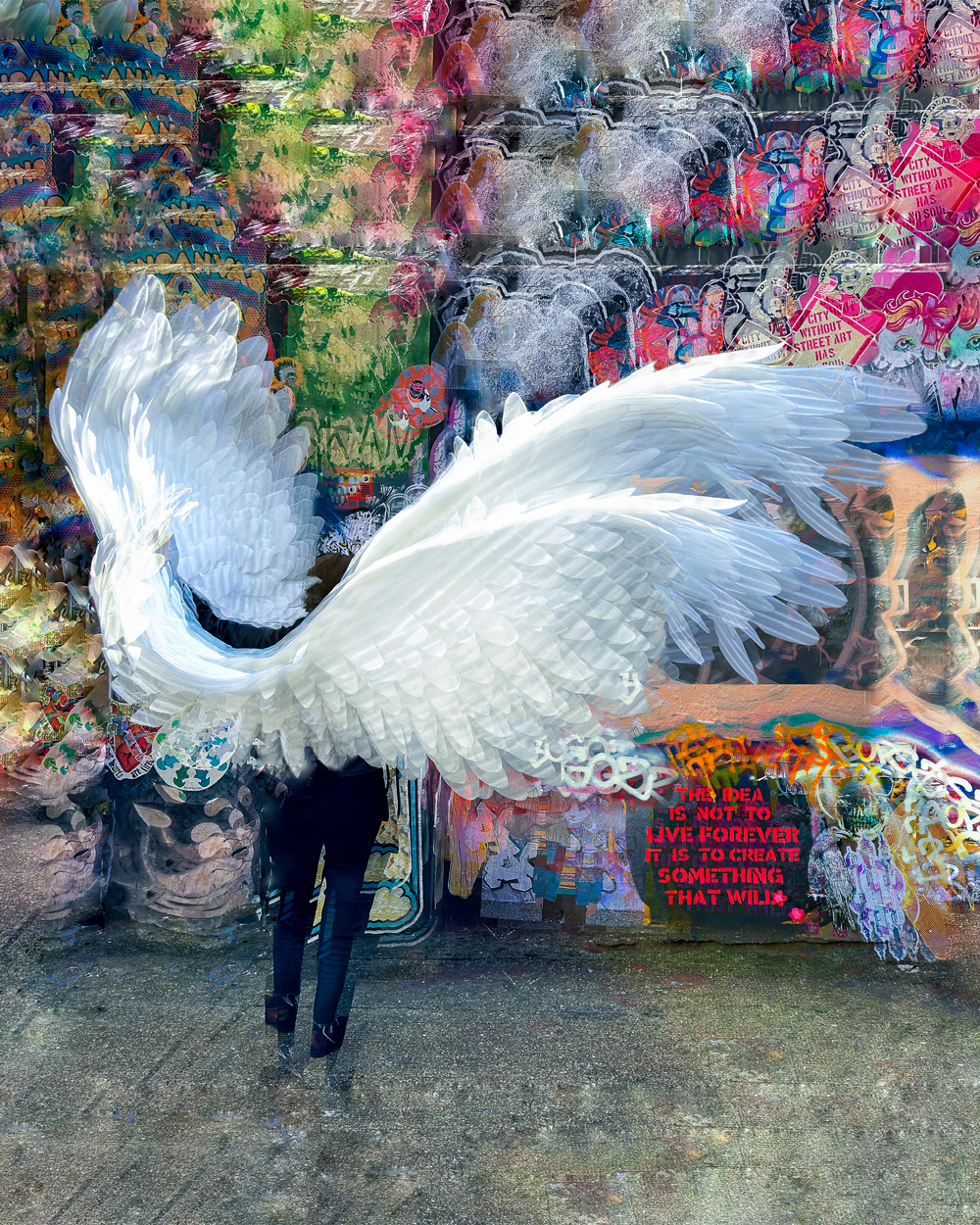
Hopefully, this figure will continue to grow as I am still receiving inquiries and further interest is being generated by media and the possibility of a book. Particularly in the case of charities, unexpected rewards come further down the line, such as donations or acquisitions made through charitable trusts. About 80% of the images sold during the exhibition — some many times over as limited edition prints. The star of the show was the only colour image I made, and I printed it very large. It was purposely the final image in the exhibition as its message was very powerful: “The idea is not to live forever. It is to create something that will.” That single sentence summed up the entire exhibition and the work of the charity.
I was interviewed on 5 Live by Naga Munchetty, which allowed me to thank her for being a catalyst in my journey and felt like coming full circle. This radio interview has also brought new sponsors to the charity and has further promoted knowledge of its services and the help it so badly requires. I always say: “You drop a pebble and you never know where the rings will reach.”
I have been supported in this endeavour by incredible friends and wonderful companies offering to discount their services or provide them for free. Along the way, I have met some truly generous angels. The experience has been a complete privilege.
Are You Next To An Angel? prints can be purchased by contacting Honey J. Walker through her website: https://www.honeyjwalker.com/
Donations to the Marylebone Project may be made through its website: https://www.maryleboneproject.org.uk
All images © Honey J Walker ARPS
About Honey J. Walker ARPS
An award-winning photographer based in London, Honey J. Walker first had successful careers in fashion and interior design.
Walker’s interest in photography started with candid portraiture of a deeply personal nature. She was always interested in the human inside the shell, and the story that was not immediately obvious to the casual observer.
Her images have become increasingly multi-layered both in camera and as part of a mixed media process. She is always experimenting and pushing her learning and creativity through experimentation.
She writes: “Within my photographs, there exists a converging of two scales: the physical world, things in themselves as they are; and the interior world, lying hidden in all things. A synchronism of the internal and the everyday.
“My interior world is expressed externally through my lens, the layering of images that find me, that reveal themselves as I work. My subconscious finding oxygen.”
Walker has been exhibited internationally and her limited edition prints are held in private collections.
Website: https://www.honeyjwalker.com/
Instagram: https://www.instagram.com/honeyjwalkerphotography/