

A sanctuary in ancient forests by Liza Faktor
In the aftermath of a health crisis, the author turned to the old-growth forests of the Pacific Northwest as a means of healing. In this personal essay, she celebrates these complex ecosystems that frequently suffer at the hands of humans, and hopes for a return to “lifeways” — to kinship with the natural world.
In early January 2025, I woke up to the news that wildfires were raging through Los Angeles. It’s hard to explain my tormented reaction to someone who hasn’t lived in a heavily forested or dry, fire-prone region — someone who hasn’t experienced a wildfire firsthand, hasn’t inhaled its acrid smoke, hasn’t witnessed its devastating consequences on humans and nonhumans alike, and doesn’t have to rely on the Watch Duty app to stay informed. Besides, I have a soft spot for the City of Angels, the mysterious futuristic place lit by the brightest sun even when covered in smog, the living dream of Blade Runner and Mulholland Drive, the place as diverse and imaginative and rich in cultures of the world as you can envision. I almost moved out there before I found myself in Oregon.
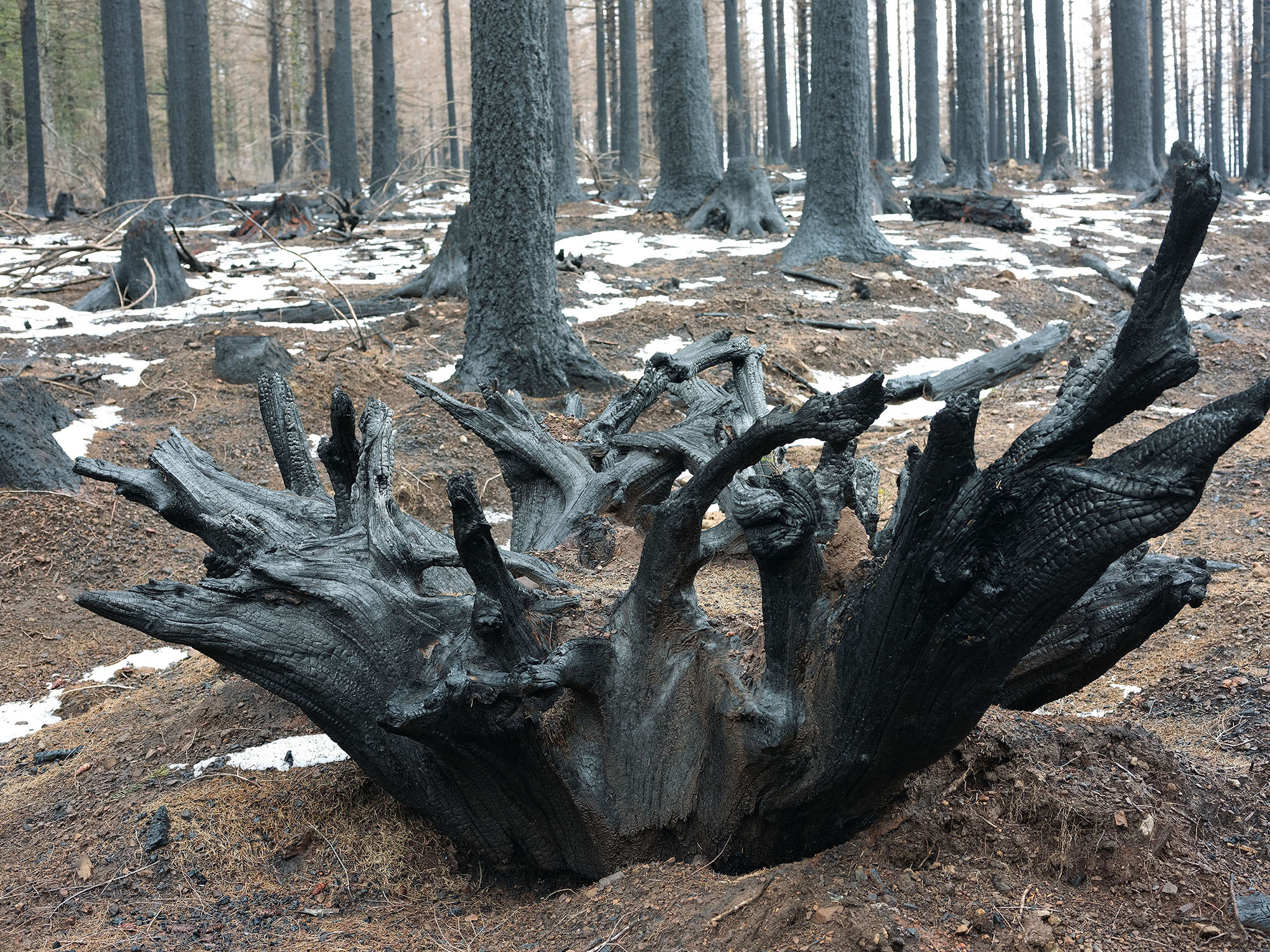
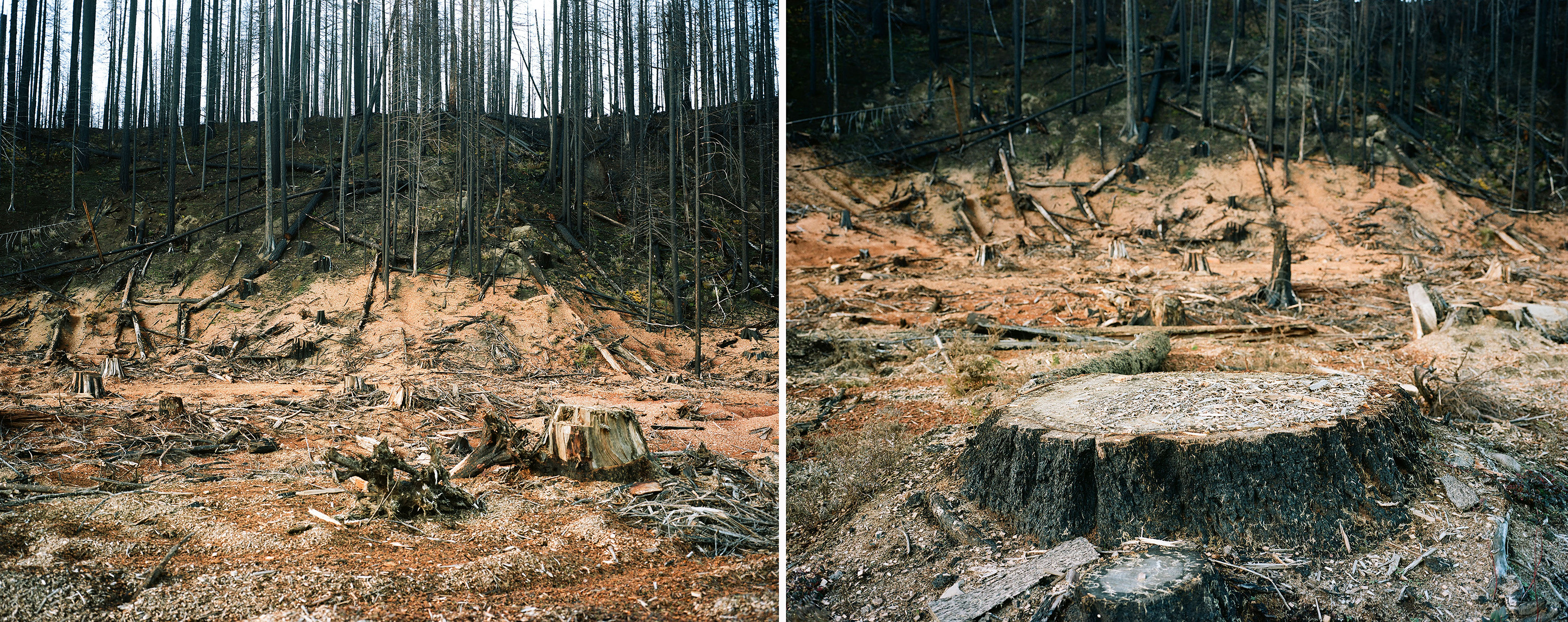
Aftermath of the 2022 wildfire, Yacolt Burn State Forest, Washington, 2023.
Every wildfire is the reality of the inevitable: the West Coast of North America is on fire. Along with many other places. We burn every year with more severity. We worship the rain.
I moved out West from New York, as I had a romantic idea of living closer to “wilderness”, to the mighty ocean, in an open space. The landscape of the Pacific Northwest also reminded me of Western Siberia, the vast region in my native Russia that I came to know intimately but remained out of my reach.
I wasn’t in a good place for a number of years, mentally or physically. I could hardly keep my professional life going and was burnt out after encountering repeated resistance to my ideas. Eventually, after a couple of years of living in Portland and traveling back and forth for work, I got to work on my dream project overseas — which was then interrupted by the pandemic. In this overwhelming silence and being so far removed from my friends and loved ones scattered all over Europe and the East Coast, all these unanswered questions resurfaced — I was angry at being so helpless, so removed, with unrealized concepts trapped in my mind. I felt like my life was slipping like sand through my fingers. And then I had a stroke. I was not surprised; something like that had to happen. I was pushing too hard in all directions.
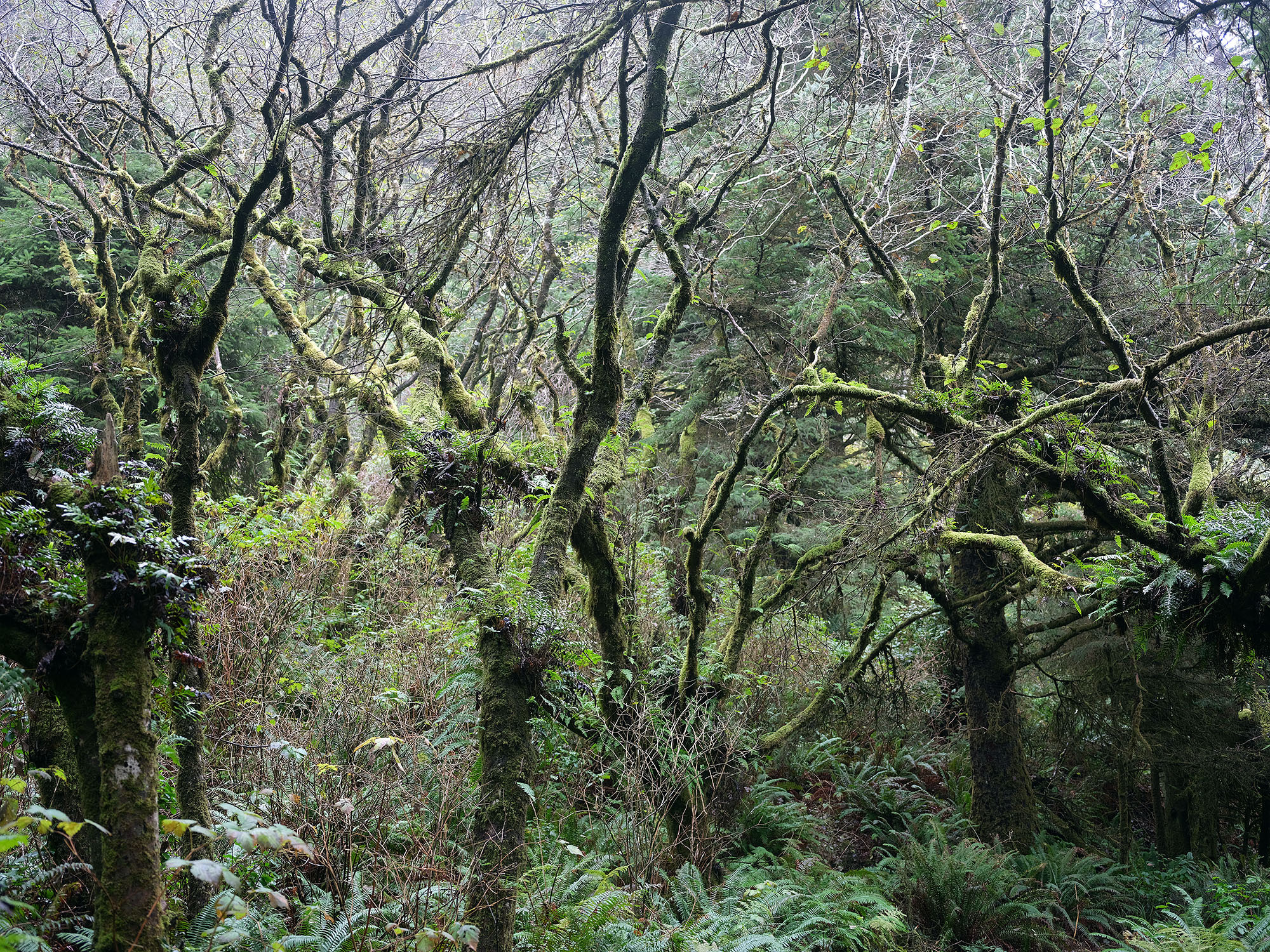
1. Ancient Sitka spruce in a protected temperate coastal rainforest, Cascade Head and the Salmon River Estuary, Oregon, 2023.
2. Wahclella Falls, Columbia River Gorge, Oregon, 2021.
It is no secret that the world burns as a consequence of human greed and arrogance. Without going too deep into the causes of the Anthropogenic climate emergency, I’ll just say that natural forests, and especially old-growth forests (not sown timber plantations), are the surest way to sequester carbon from the atmosphere and avoid the tipping point of no return. They are postponing our extinction and providing habitat to numerous living beings. Most people, sadly, have never been to an ancient or old-growth forest. There’s only a fraction of ancient forests left in the world, and I happen to live in a place that still has unique, majestic temperate rainforests that have never been logged or disturbed by human activity.
Despite their value, we are still logging mature and old-growth forests in the US. On top of that, we were afraid of fire for most of the 20th Century — it threatened our livelihood, homes, cattle, and forest as an extractable resource. As a result, the forest management policy over the past 100 years has been the suppression of fire. Finally, we have turned to Indigenous communities to teach us the traditional ecological knowledge of respecting and attending to fire.
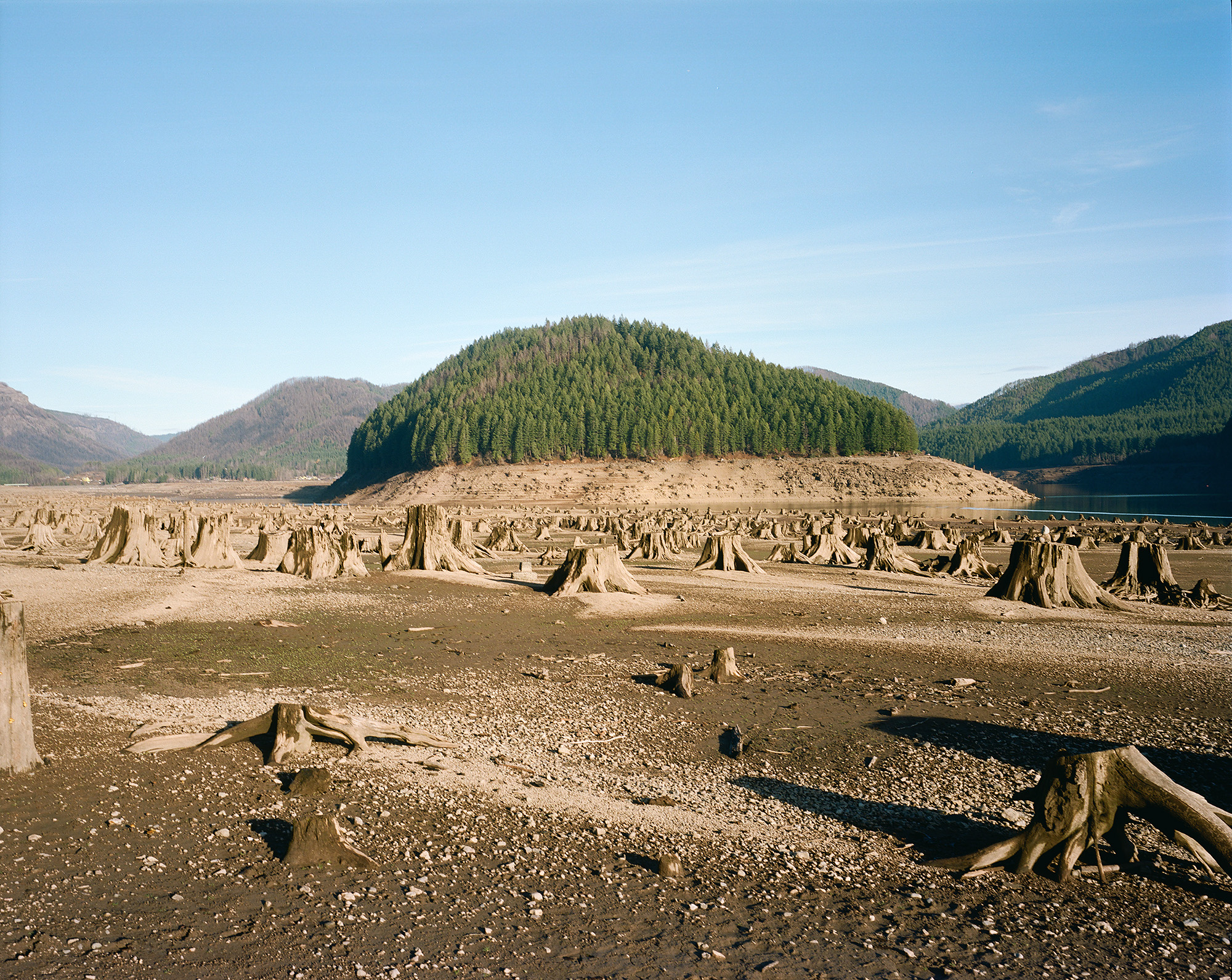
The bottom of human-made Detroit Lake, Oregon, 2021. When the water levels recede in the winter months, the stumps of the logged ancient forest are revealed.
I turned to the forest instinctively to ground myself. It was after the health trauma, after the unraveling of uprootedness and the generational traumas that I’ve stored for too long. I wanted to find a key to the landscape where I’ve been living for the past few years. What followed was a long-term investigation of the forest ecosystems and the role they play in preventing climate collapse. This would eventually lead to my series, After Us.
In the beginning, the extensive research that I embarked on, both as an artist and a curator, was painful. I was overcome by a sense of loss, both the personal loss and the much larger sixth mass extinction event that we are living through. I contemplated the dubious future of our species. It’s one thing to be intellectually aware of the threats facing the environment and quite another, to be inside the ecosystem, to read the land.
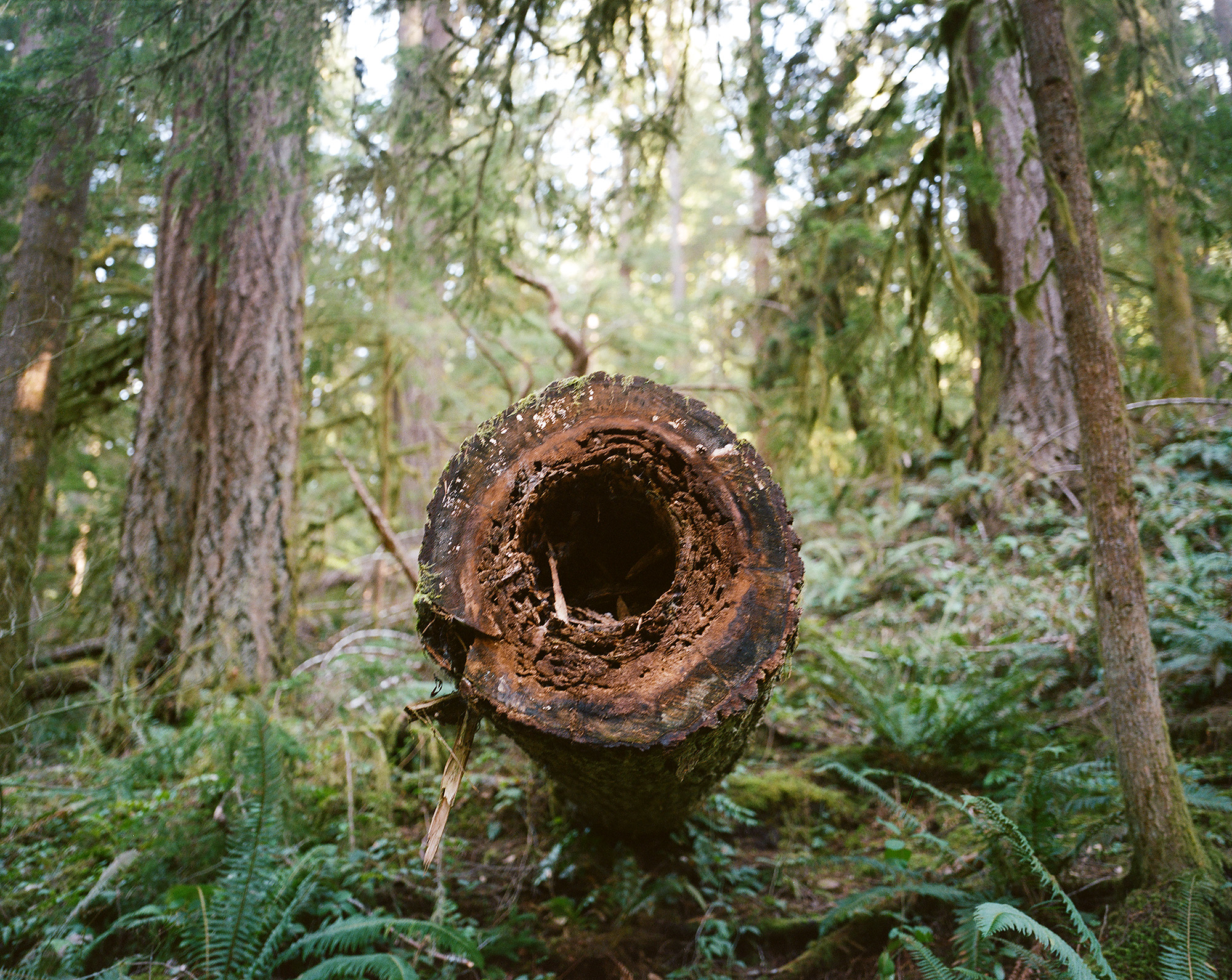
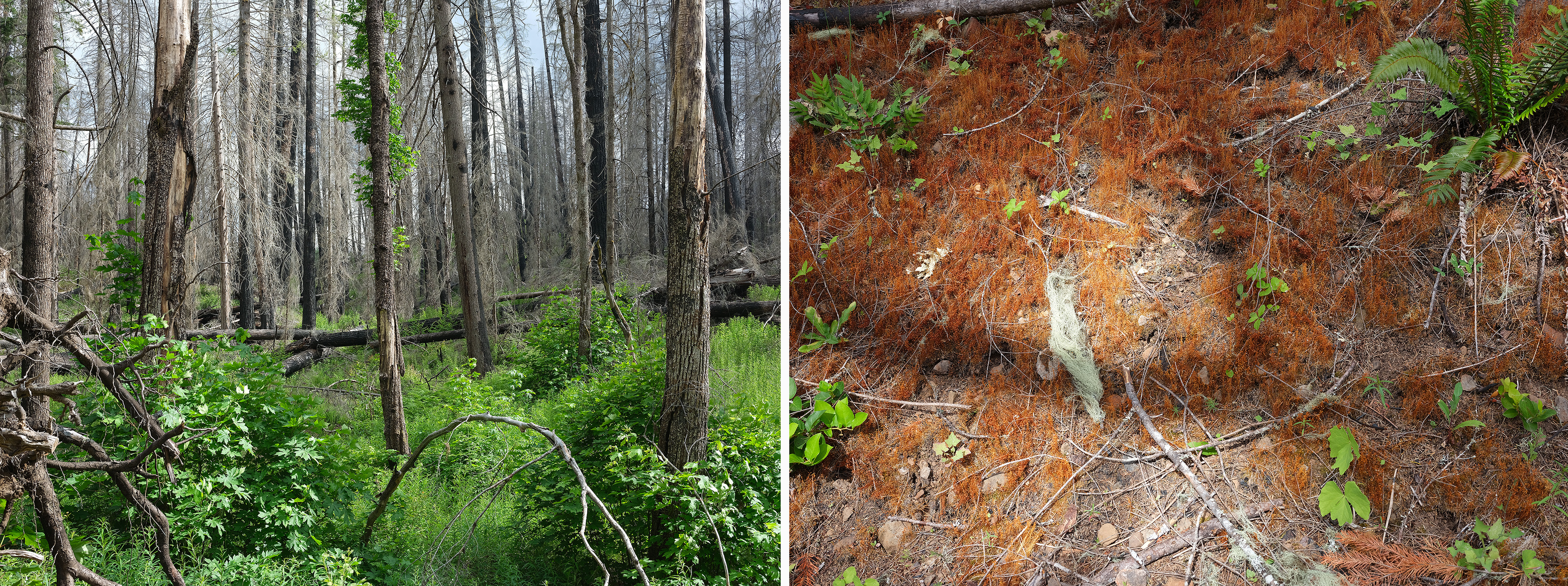
Forest recovering from the devastating 2020 Riverside fire, Mt. Hood National Forest, Oregon, 2023.
A felled dead tree left to naturally decompose in Willamette National Forest, Oregon. This forest is the top timber producer of the 156 national forests in the US, and provides an average of 750 million board feet of timber to the nation's economy annually.
Symptomatically, my artistic inquiry into Pacific Northwest forest ecosystems began in 2021 when I saw the aftermath of a major wildfire. We take pictures when we are responding to the impulse, a signal from the environment, and not because we have read books and scientific research. What feels like a massacre usually proves to be a massacre.
I found myself in the Willamette National Forest a year after it suffered from the devastating 2020 wildfires — I was gutted and deeply disturbed by how I saw the fire-scarred trees being hastily cut down by the Forest Service. I thought about all the violence that we, humans, cause to ourselves and other species and I wondered what nonhumans are thinking and how they process their loss and grief.
"The most inspiring and magical sight I have experienced is watching the forest regenerate after wildfire, it's full of life and birdsong"
When I enter the majestic ancient forest, I forget about humanity. Or rather I dissolve in the abundance of life — ferns, moisture, giant trees, moss, sounds of rain, streams, bird calls and the overwhelming presence of nonhumans. The more time I spend in the forest and exist in this state of unity with the natural world — listening to plants and following the light — the more tangible the growth of things around me becomes. The flowering, the emergence of new life, the popping of the fungi, and the germination of something inside of me coming into light and existence. I’m able to move beyond the limitations of the short human lifespan and feel the duration of deep time.
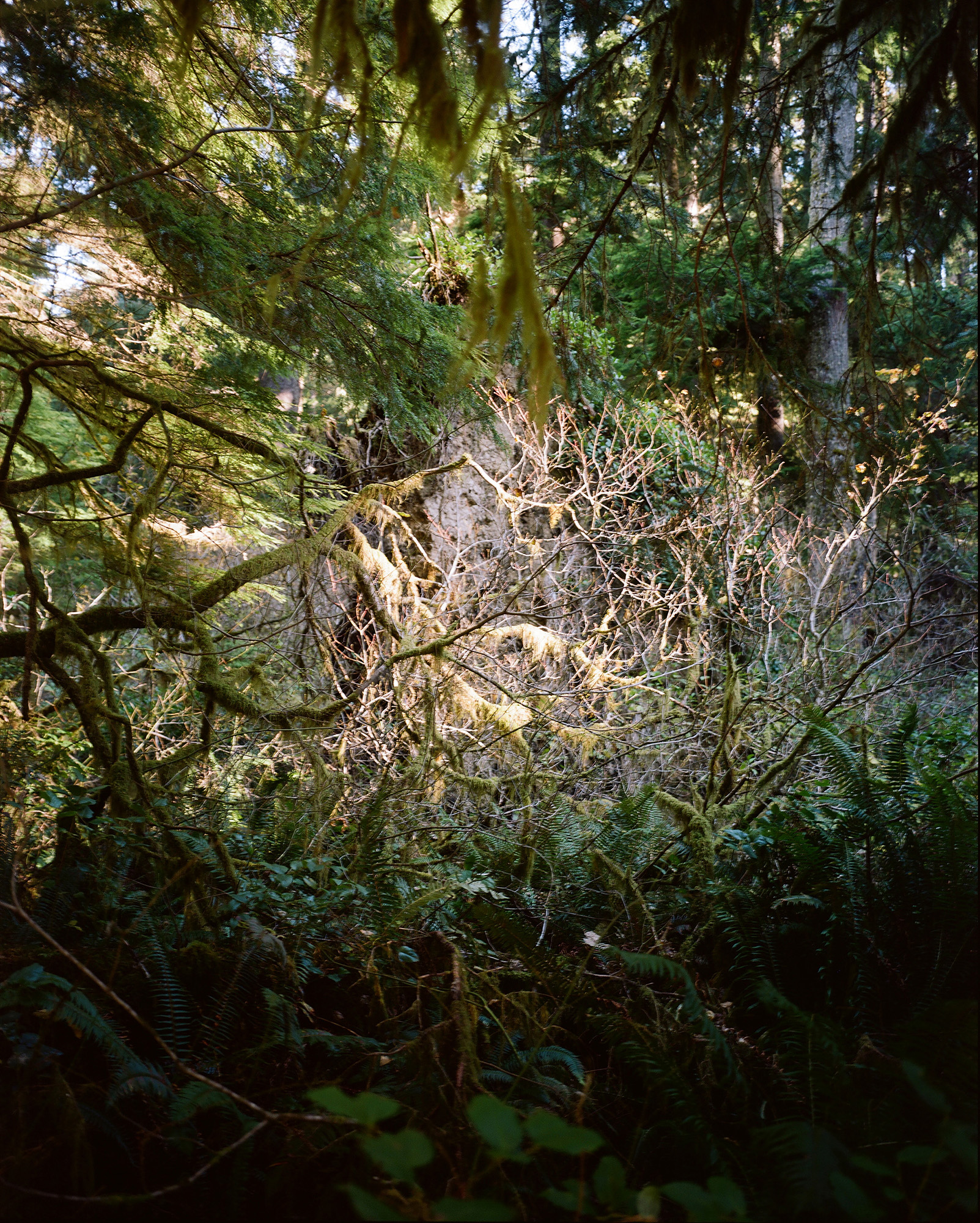
Protected temperate coastal rainforest, Oswald West State Park, Cape Falcon, Oregon, 2021.
What is a forest? It’s not just trees, it is a complex ecosystem with interrelated and interdependent things alive and transitioning. Science has barely scratched the surface of this primal network of relationships. I sense so much more from my being within the forest world. The most inspiring and magical sight I have experienced is watching the forest regenerate after wildfire; it’s full of life and birdsong.
I became aware of the amazing intelligence of nonhumans for whom these vanishing habitats are home. This new knowledge gave me unexpected joy and hope. I started to notice self-healing in severely burnt or logged forest, repeating patterns in the landscape, landmarks. The awareness of our thin layer in geological time and the feeling of unity with other species with whom we share DNA gave me some perspective on the state of my own body and human existence — a way to process grief and face the future.
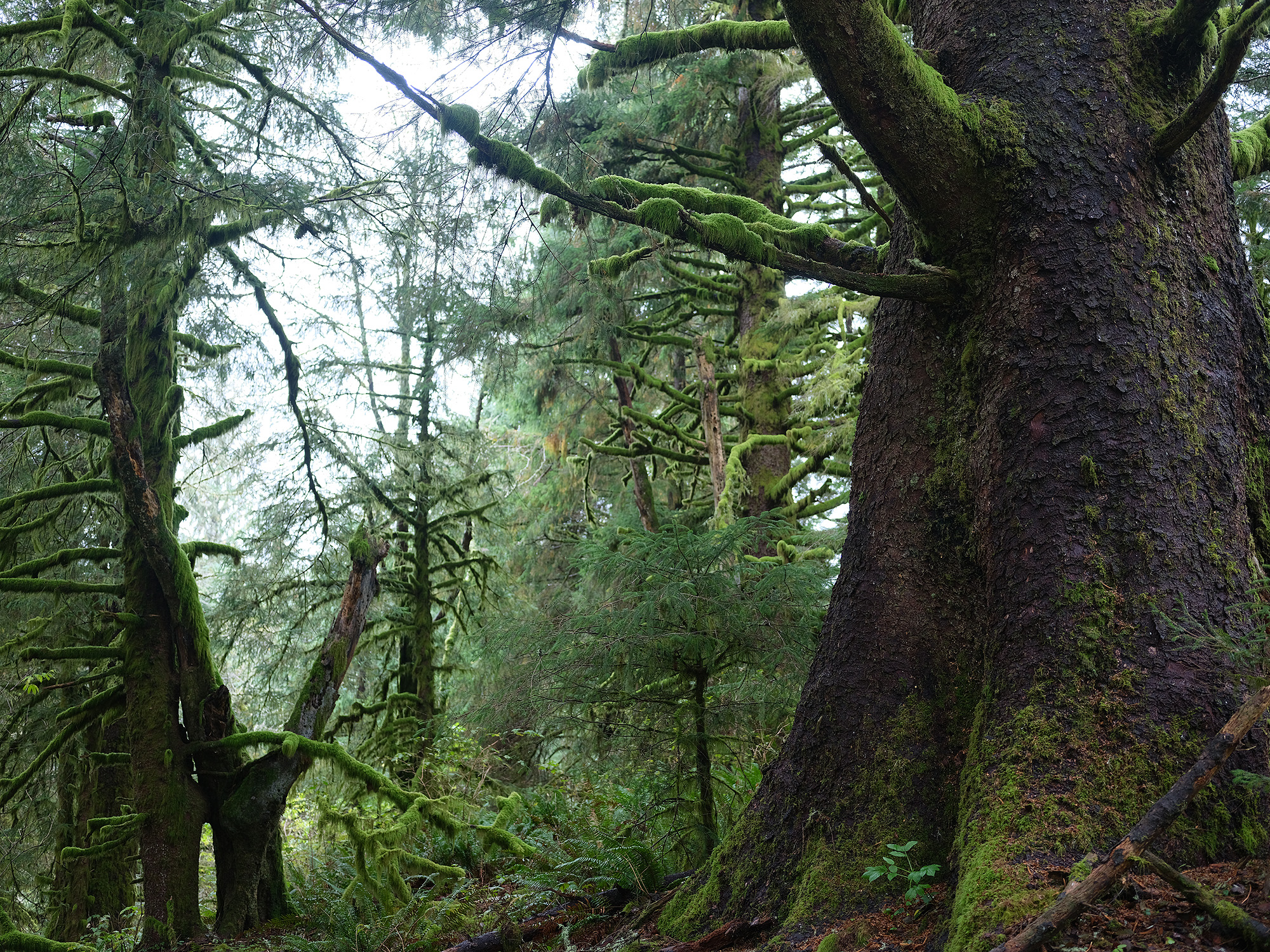
Ancient forest section, Eagle Fern Park, Oregon, 2022.
My forest exploration and my healing journey have resulted in After Us — a series that explores the resilience of forests to human intervention, memories stored in the landscape, and prehistoric, prehuman and pre-industrial serenity. It led me to recalibrate my creative practice towards the climate emergency and healing, and a larger curatorial inquiry — an evolving inventory of visual, sound and immersive artworks by artists responding to the forests. As I look ahead, I’m hopeful that we’ll find our way back to the severed umbilical cord that used to connect us to the natural world and re-establish our kinship with all living beings, that we will turn towards vital traditional knowledge and wisdom and restore “lifeways”.
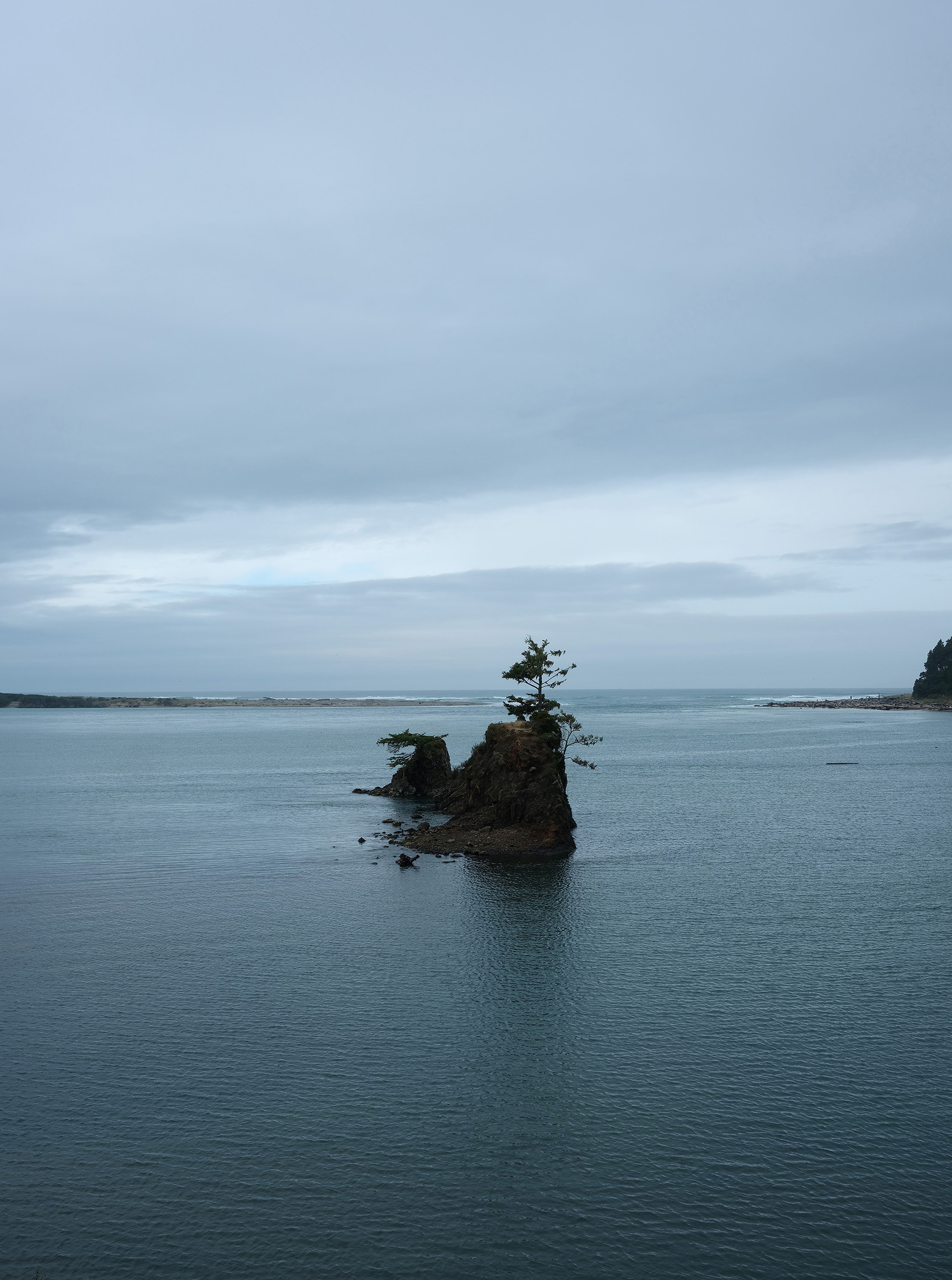
Tree separated from the coastal rainforest by the incoming tide, Lincoln City, Oregon, 2023.
Author’s note:
Oregon Wild has been protecting ancient and old-growth forests for the past 50 years. They are the environmental nonprofit that I consulted with the most for this work. They provide a good explanation of the climate benefits of old-growth forests.
The After Us project was supported by Oregon Regional Arts & Culture Council and The Ford Family Foundation.
All images © Liza Faktor
About Liza Faktor
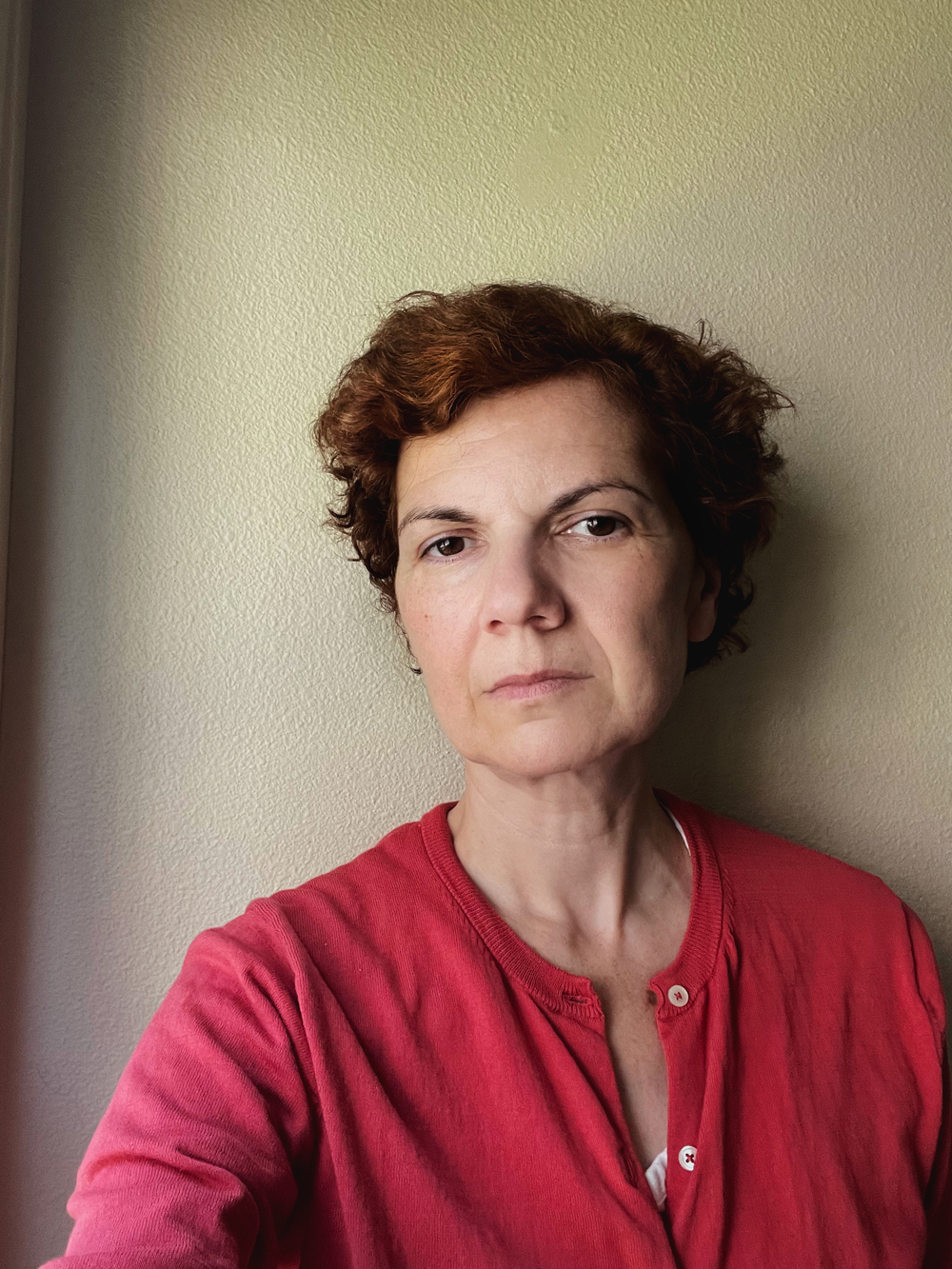
Liza Faktor is a visual artist and independent curator. Her practice explores the intertwined memories, histories and traumas of humans and the land, how both we and the landscapes process violence, and how we might heal. She is interested in how our various geographies are connected through the colonial past, as well as in the extraction economy, and in the future of the natural world. Her work has been exhibited in Spain, Norway, China, Russia, the UK and the US, and is in various international private collections.
Alongside her own artistic practice, Liza works as a curator and creative producer with visual artists on award-winning installations and multi-platform projects. She has curated over 20 exhibitions and festival programs at the intersection of photography, the moving image, and emerging media, and has lectured and taught workshops in a number of countries. She immigrated to the US from Russia in 2010 and is based in Portland, Oregon.
Website: https://lizafaktor.com/
Instagram: @faktorl