
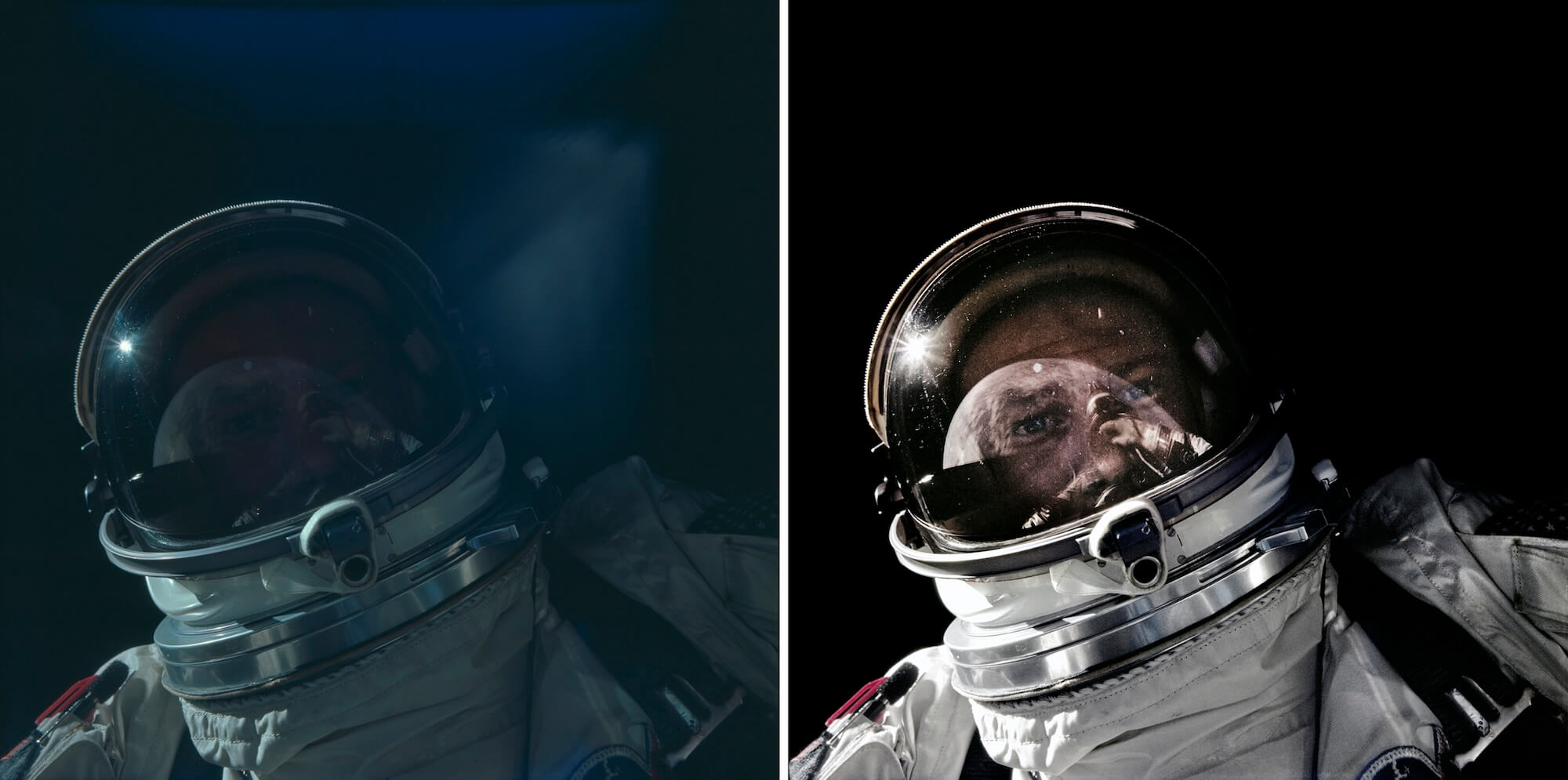
‘The first selfie taken in space’ by Buzz Aldrin, before and after digital restoration. Image credit: NASA/ASU/Andy Saunders
Before Neil Armstrong took “one giant leap for mankind”, the foundations of space flight were being laid by the astronauts involved in Project Mercury and the Gemini missions of the mid-1960s.
Now, seven decades on, renowned NASA digital restoration expert Andy Saunders is illuminating the images captured by these pioneers.
Following on from his bestselling title Apollo Remastered is his latest book, Gemini and Mercury Remastered, for which he has painstakingly restored images taken by astronauts including Buzz Aldrin and Jim Lovell.
Saunders, recipient of the 2023 RPS Award for Scientific Imaging, has curated and enhanced images from an archive of more than 5,000 photographs taken during the Mercury and Gemini missions. Using an image-stacking technique often used in astrophotography, he reveals detail and depth unseen for almost six decades.
“To me, these missions represent not only some of the most important moments in space flight, but in human history,” he says. “The photographs the astronauts captured will forever symbolise this golden era in which the ancient dream of leaving Earth, to fly among the stars, finally became reality. As such, I believe they are some of the most important photographs ever taken.
“I’ve often dreamt of being able to travel back in time, to climb on board and witness these historic journeys firsthand. Impossible of course, but working on the images, bringing them to life, is the next best thing.
“I become deeply connected to them. It’s such an immersive process – more visceral. Although it’s an extraordinary amount of work it really is a privilege. When the detail is revealed and the colours leap to life, there is the reward. It really does feel like archaeology sometimes – brushing the dust away to reveal something that’s remained hidden for so long.
“We’ve relied on copies of copies of duplicate film for too long. These images are too important not to be seen at their best. When I see versions online – which again are copied so frequently, leading to further degradation – I feel so frustrated. Things should get better, not worse.
“So, if shining a whole new light on these missions so we can see them as never before helps contribute to the legacy of such important moments in history, that’s time well spent, and I feel deeply honoured.”
Here, Saunders selects seven groundbreaking images from Gemini and Mercury Remastered.
1. (see main image above) ‘12 November 1966, GMT 17:45, Rev 14’ by Buzz Aldrin. Image credit: NASA/ASU/Andy Saunders
“The first selfie taken in space. ‘Well, I have 50 [frames taken] showing on here,’ said the astronaut Buzz Aldrin. ‘I might as well take a couple until it’s all over … Now let me raise my visor and I’ll smile.’ In this restored image, Aldrin is clearly visible through his visor as he takes the first selfie in space during Gemini 12 in November 1966 – decades before selfies became a thing. Aldrin was barely visible in the previous, lower quality imagery (top left).”
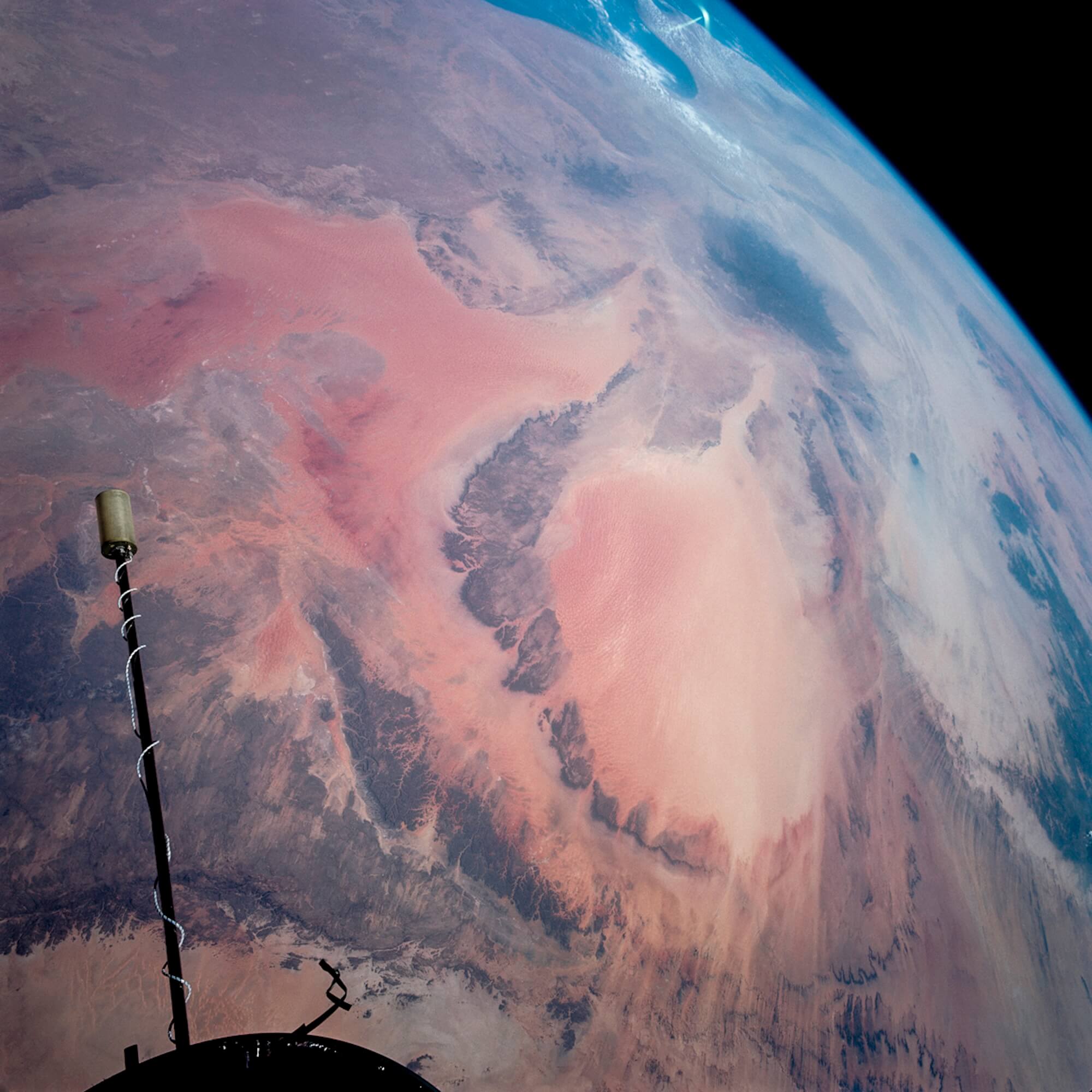
2. ‘14 September 1966, GMT 09:06, Rev 27’ by Richard Gordon. Image credit: NASA/ASU/Andy Saunders
“Astronauts on board the Mercury and Gemini missions took not only the first, but still some of the finest photographs of Earth ever captured on film. It could be mistaken for a distant world from the scene of a sci-fi movie, but this is our planet from 275 miles above, taken during Gemini 11 in September 1966. The crew witnessed the colour contrast between the Mediterranean Sea (the Gulf of Sidra, top) and the varied desert sands of the Sahara. Dune formations can be seen in and around the Murzuq Desert – the circular area center right, in Libya.”

3. ‘20 February 1962, GMT 18:13, Orbit 3.’ Image credit: NASA/ASU/Andy Saunders
“John Glenn inside his tiny Mercury capsule Friendship 7 on 20 February 1962 as he became the first American in orbit. This image was produced by stacking more than 100 separate frames of small format, 16mm movie film. I developed this process, similar to one used in astrophotography, during my Apollo Remastered project, revealing the first clear, recognisable image of Neil Armstrong on the Moon. Applying the technique for Gemini and Mercury Remastered allows us to effectively climb on board these tiny spacecraft and ride along with these space pioneers during some of the most important ever human expeditions.”

4. ‘3 June 1965, GMT 19:52 to 19:54, Orbit 3’ by Jim McDivitt. Image credit: NASA/ASU/Andy Saunders
“Gemini 4 took the first ever portraits in space. In this image, astronaut Ed White is floating in the void on 3 June 1965 – the second man and the first American to perform a spacewalk. These photographs of a human form against the backdrop of Earth really wowed the public and were a clear turning point in NASA’s appreciation of the benefits of space photography. White, also featured on the cover of Gemini and Mercury Remastered, was later tragically killed in the Apollo 1 fire in January 1967.”
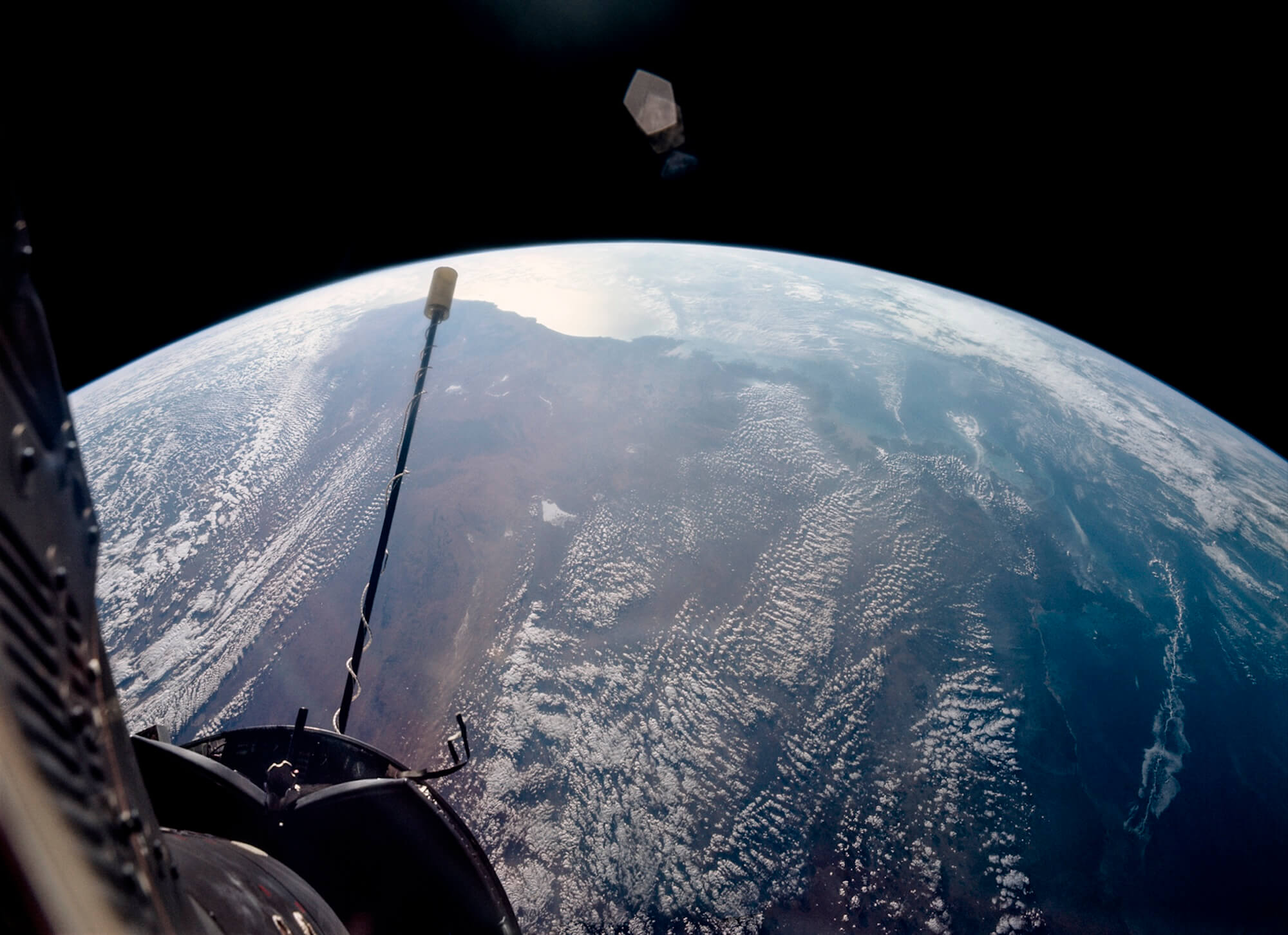
5. ‘14 September 1966, GMT 07:58, Rev26’ by Richard Gordon. Image credit: NASA/ASU/Andy Saunders
“One of the reasons Earth photography from Gemini is so unique is that they flew to altitudes way beyond where we typically go today. The ISS orbits at around 200-250 miles, whereas Gemini 11, seen here, reached more than 850 miles. It held the Earth orbit altitude record for 58 years, surpassed only last year by SpaceX’s Polaris Dawn mission. This image shows two photographs taken just before apogee (peak altitude), digitally remastered and stitched into a panorama.”
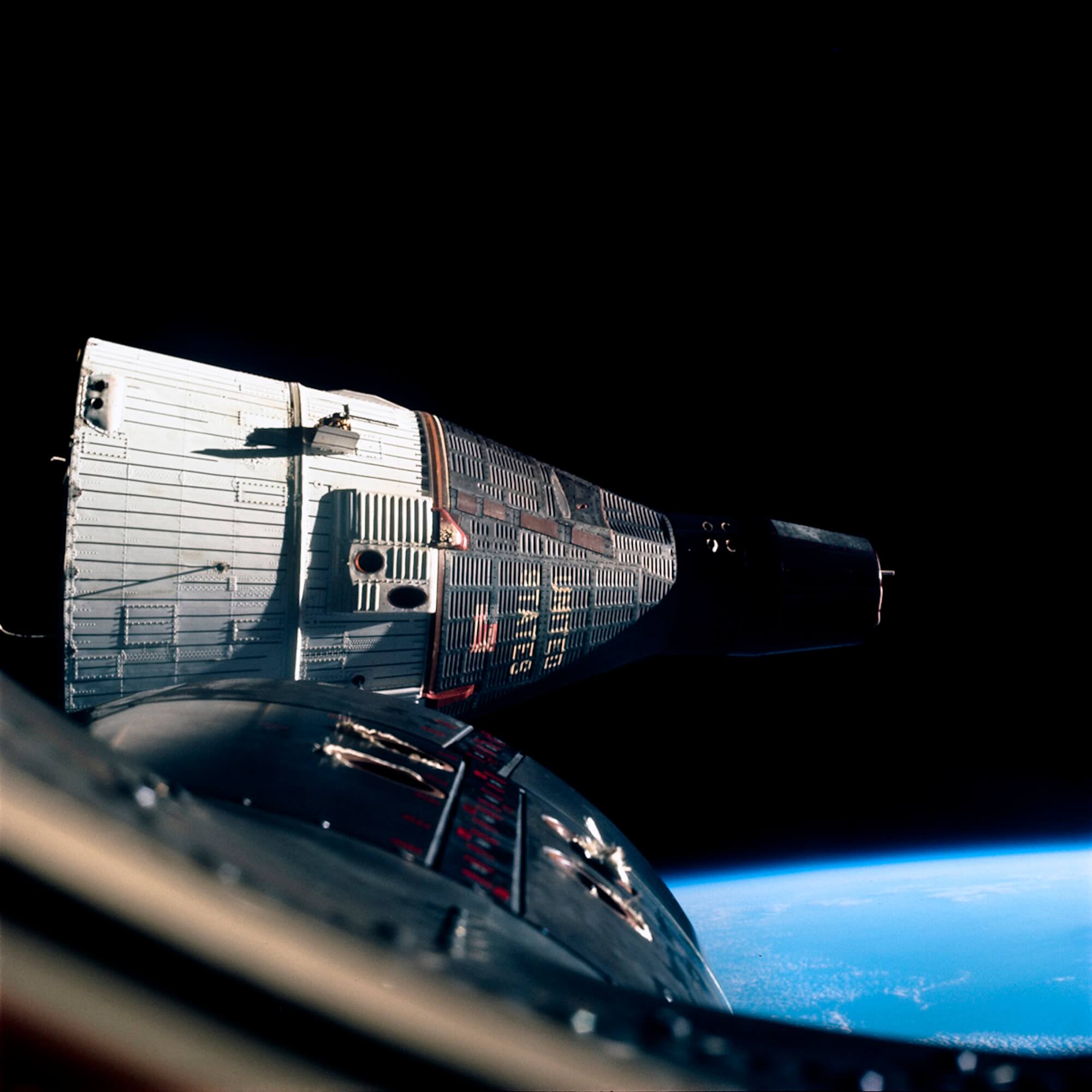
6. ‘15 December 1965, GMT 21:43, Rev 5’ by Tom Stafford. Image credit: NASA/ASU/Andy Saunders
“This photograph of Gemini 7 was taken from Gemini 6-A at close quarters during the world’s first rendezvous in space, on 15 December 1965. Rendezvous – two spacecraft meeting in space – was a key concept required for a future trip to the Moon. The crews took it in turns to fly around and inspect each other’s spacecraft. Despite travelling at more than 17,000mph, they manoeuvred to within inches of each other. The astronauts could clearly see and photograph each other in their capsules through the windows.”

7. ‘12 December 1865, GMT 22:59, Rev 123’ by unknown. Image credit: NASA/ASU/Andy Saunders
“Jim Lovell on board Gemini 7. ‘Photograph at f/5.6, 1/250, at 195:29:30 [mission elapsed time] … wave clouds over the Andes, near Bolivia … magazine C, exposure 59.’ The low Sun illuminates the cloud line like a golden fire as the crew crosses Earth’s terminator – the shadow line between day and night. Gemini 7 set the world space longevity record – Lovell and Frank Borman were cooped up in their tiny capsule for almost 14 days. Long duration space travel was just one of many concepts Gemini had to demonstrate to allow the following Apollo programme to reach for the Moon.”
Andy Saunders is the recipient of the 2023 RPS Award for Scientific Imaging. His latest book, Gemini and Mercury Remastered, is published by Particular Books at £50.
The RPS Journal is available exclusively to members. Join us to receive our award-winning magazine and read more inspiring features. Explore full member benefits here.